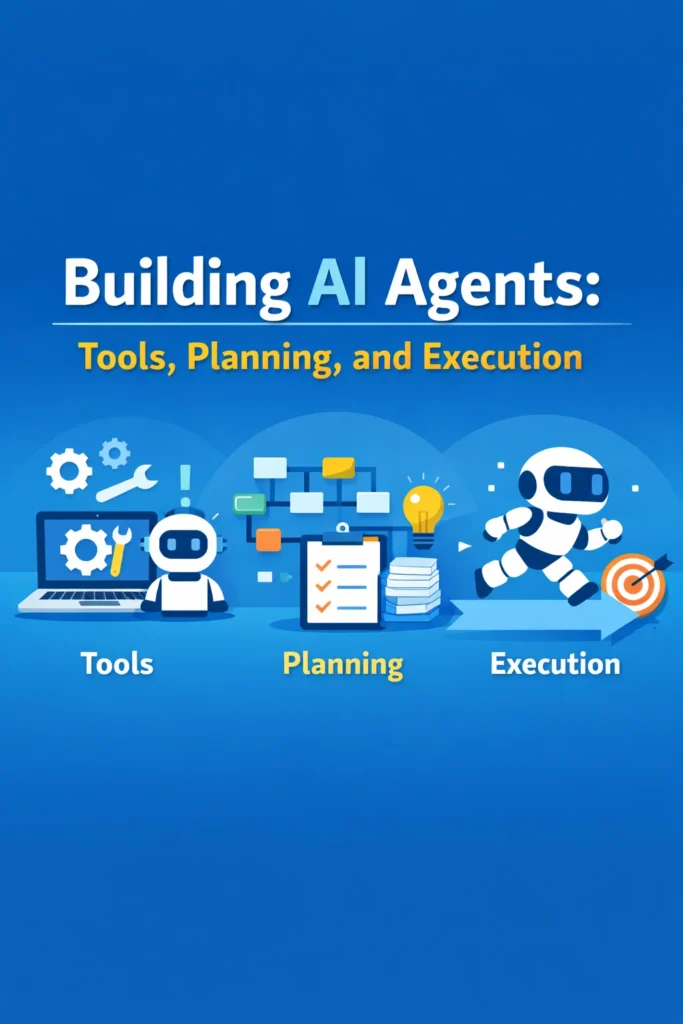
AI agents represent a shift from single-response language models to goal-driven systems. Instead of answering one prompt, an agent can plan, take actions, observe results, and adapt. This makes agents suitable for tasks that require reasoning, decision-making, and interaction with external systems.
This article explains how to build AI agents from a practical engineering perspective. You will learn how tools enable action, how planning guides behavior, and how execution loops turn models into autonomous systems.
What Makes an AI Agent Different from a Chatbot
A chatbot responds to input. An AI agent pursues an objective.
The key difference is state and intent. An agent maintains context across steps, decides what to do next, and evaluates outcomes. This allows agents to perform multi-step tasks such as researching information, modifying data, or coordinating workflows.
If you have already built systems with streaming chatbots, you have seen the foundation of agent behavior. Agents extend that foundation with planning and action.
Core Components of an AI Agent
Every AI agent, regardless of complexity, is built from the same core components.
At a high level, an agent consists of:
- A goal or objective
- A planning mechanism
- A set of tools or actions
- An execution loop
- A memory or state store
These components work together to move the agent toward its goal while adapting to new information.
Tools: Giving Agents the Ability to Act
Tools are how agents interact with the outside world. Without tools, an agent can reason but cannot act.
Tools typically include:
- API calls
- Database queries
- File operations
- Search or retrieval functions
- System commands
Instead of embedding logic in prompts, tools provide structured interfaces with defined inputs and outputs. This reduces hallucinations and makes agent behavior auditable.
If you are familiar with structured tool usage from getting started with the Claude API, the same principles apply directly to agent systems.
Planning: Deciding What to Do Next
Planning is what separates agents from scripted workflows.
Rather than executing a fixed sequence of steps, an agent evaluates the current state and decides the next action. Planning can be as simple as selecting the next tool or as complex as generating multi-step plans with contingencies.
Common planning strategies include:
- Single-step reasoning per iteration
- Multi-step plan generation
- Goal decomposition into sub-tasks
- Reflection and self-evaluation
Planning does not need to be perfect. In fact, many successful agents rely on iterative planning, where the plan is refined as new information becomes available.
These ideas align closely with concepts discussed in prompt engineering best practices for developers, where structure and intent guide model behavior.
Execution Loops: Turning Reasoning into Progress
The execution loop is the heart of an AI agent.
A typical loop looks like this:
- Observe the current state
- Decide on the next action
- Execute the action using a tool
- Observe the result
- Update state and repeat
This loop continues until the goal is achieved or a stopping condition is met.
Execution loops must be carefully designed to avoid infinite cycles, runaway costs, or unsafe actions. Guardrails such as step limits, cost budgets, and explicit termination conditions are essential in production systems.
Memory and State Management
Agents need memory to operate effectively. Without memory, each step becomes isolated.
Memory can include:
- Conversation history
- Intermediate results
- Tool outputs
- Partial plans
Memory does not have to be permanent. Many agents use short-term memory for execution and long-term storage for learning or retrieval.
If you are already using RAG from scratch, retrieval-based memory can be integrated directly into agent workflows to provide context on demand.
A Realistic AI Agent Use Case
Consider an internal operations agent responsible for triaging incidents.
When an alert arrives, the agent:
- Analyzes logs
- Queries recent deployments
- Checks system metrics
- Proposes remediation steps
No single prompt can handle this reliably. An agent with tools, planning, and an execution loop can reason step by step, gather evidence, and adapt its approach as new data appears.
This pattern mirrors how human operators work and is where AI agents provide the most value.
Common Mistakes When Building AI Agents
One common mistake is over-automation. Giving agents too much autonomy without constraints leads to unpredictable behavior.
Another issue is treating planning as a one-time step. Plans should evolve as execution progresses.
Finally, many teams underestimate observability. Without logging decisions, tool calls, and state transitions, debugging agents becomes nearly impossible.
Lessons from monitoring and logging in microservices apply directly to agent systems.
When AI Agents Are a Good Fit
AI agents excel when:
- Tasks require multiple steps
- Decisions depend on intermediate results
- Human workflows are slow or repetitive
- Flexibility is more important than determinism
When AI Agents Are Not the Right Choice
Agents are not ideal when:
- Tasks are simple and deterministic
- Latency must be extremely low
- Actions must be strictly controlled
- The problem is better solved with traditional automation
In these cases, simpler pipelines or rule-based systems are often more reliable.
AI Agents in Larger Architectures
AI agents rarely operate alone. They are often part of larger systems that include APIs, databases, and human oversight.
Agents can act as orchestrators, coordinating other services and tools. This makes them a natural fit for modern backend architectures, where responsibilities are distributed across services.
If you are already thinking in terms of system boundaries, ideas from API gateway patterns for SaaS applications provide useful parallels.
Conclusion
Building AI agents is about combining reasoning with action. Tools enable interaction, planning provides direction, and execution loops create progress. When designed carefully, agents can handle complex, real-world tasks that go far beyond single-turn chat.
A practical next step is to build a small agent with a single goal and two or three tools. Observe how it plans, where it fails, and how constraints improve reliability. Those insights scale far better than starting with a fully autonomous system.
6 Comments