Frontend Development React & Next.js Tailwind CSS Best Practices for React and Next.js Projects Tailwind CSS has become a dominant styling solution for modern React and Next.js projects. Its utility-first approach enables fast development,...
Frontend Development React & Next.js React Performance Optimization: memo, useMemo, useCallback Explained React performance issues rarely come from React itself. Instead, they usually come from unnecessary re-renders, repeated calculations, or unstable references...
Data Layer Database Redis Data Structures Beyond Caching: Lists, Sets, Sorted Sets Redis is often introduced as a fast in-memory cache, but treating it only as a cache leaves most of its...
Frontend Development React & Next.js Building Forms in React with React Hook Form and Zod Validation Forms are one of the hardest parts of frontend development. They combine user input, validation rules, async submission, error handling,...
Data Layer Database MongoDB Aggregation Pipeline: From Basics to Advanced MongoDB’s aggregation pipeline is one of its most powerful features—and one of the most misunderstood. It allows you to transform,...
Data Layer Database Database Migrations in Production: Strategies and Tools Database migrations are easy in development and unforgiving in production. A migration that works locally can lock tables, break running...
Frontend Development React & Next.js State Management in React 2026: Redux Toolkit vs Zustand vs Jotai State management in React has evolved significantly. In 2026, choosing the “best” library depends less on trends and more on...
Data Layer Database PostgreSQL JSONB: When to Use It and Best Practices PostgreSQL JSONB sits at the intersection of relational databases and document stores. It offers flexibility that traditional schemas cannot, while...
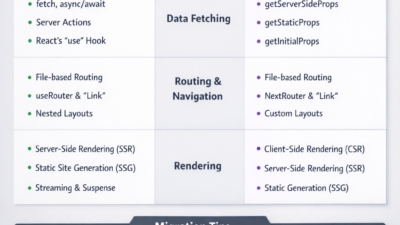
Frontend Development React & Next.js React Server Components Explained: When and Why to Use Them React Server Components (RSC) are one of the biggest architectural changes in React in years. Even so, many teams either...