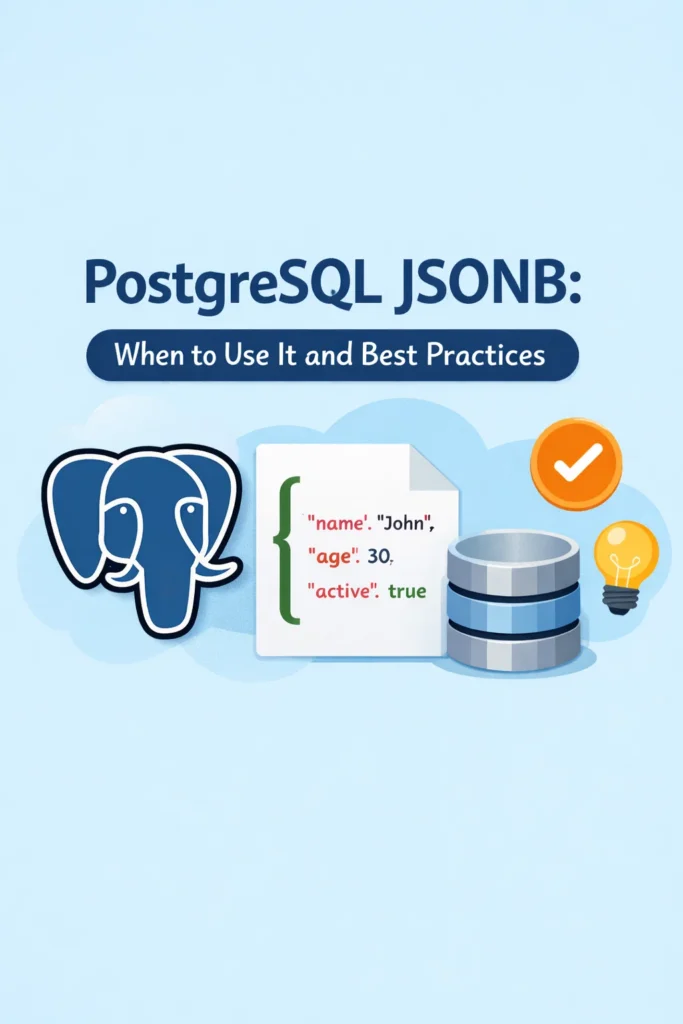
PostgreSQL JSONB sits at the intersection of relational databases and document stores. It offers flexibility that traditional schemas cannot, while still benefiting from PostgreSQL’s transactional guarantees. Used correctly, JSONB can simplify models and accelerate development. Used incorrectly, it can quietly undermine performance and data integrity.
This article explains when PostgreSQL JSONB is the right choice, when it is not, and the best practices that keep JSONB usage safe and scalable in production.
Why JSONB Exists in PostgreSQL
Traditional relational schemas require you to know your data shape in advance. That works well for stable domains but becomes painful when attributes are optional, evolving, or user-defined.
JSONB exists to handle those cases. It allows semi-structured data to live alongside relational data without forcing schema migrations for every small change.
If you are already designing systems that balance flexibility and structure, similar trade-offs appear in REST vs GraphQL vs gRPC, where rigid contracts and dynamic queries must be weighed carefully.
JSON vs JSONB: Why JSONB Matters
PostgreSQL supports both json and jsonb, but they behave very differently.
The json type stores raw text. PostgreSQL must parse it every time it is queried.
The jsonb type stores a binary representation optimized for querying and indexing. Keys are normalized, duplicates are removed, and access is much faster.
In practice, jsonb should be the default choice unless you explicitly need to preserve raw formatting.
When PostgreSQL JSONB Is a Good Fit
JSONB works best when data is:
- Optional or sparse
- User-defined or dynamic
- Read-heavy rather than write-heavy
- Queried by keys rather than joined relationally
Common examples include metadata, configuration objects, feature flags, and extensible attributes.
This pattern appears frequently in systems that evolve rapidly. If you are building APIs that change shape over time, ideas from building scalable Express.js project structures apply just as much at the data layer.
When PostgreSQL JSONB Is the Wrong Choice
JSONB is not a replacement for relational modeling.
Avoid JSONB when:
- Data has strong relational constraints
- You need frequent joins across entities
- Columns are queried and indexed individually
- Updates touch large portions of the JSON document
Storing core business entities entirely inside JSONB often leads to poor query performance and loss of database-level guarantees.
A good rule of thumb is this: if a field is critical to filtering, joining, or reporting, it probably belongs in a real column.
Querying JSONB Effectively
PostgreSQL provides powerful operators for JSONB, but careless usage can degrade performance.
Key-based access is efficient when paired with proper indexing. However, deep nesting increases query complexity and can obscure intent.
Queries that repeatedly extract the same JSON paths should be reviewed carefully. In many cases, promoting frequently accessed fields to top-level columns improves clarity and performance.
This mirrors lessons discussed in PostgreSQL performance tuning, where visibility into execution plans is essential.
Indexing Strategies for JSONB
Indexing is where JSONB either shines or becomes a liability.
GIN indexes are the most common choice for JSONB. They allow efficient searching across keys and values, but they come with higher memory and write overhead.
Partial indexes can significantly reduce index size when queries target a known subset of documents.
Expression indexes are useful when a specific JSON path is queried frequently. They trade flexibility for speed and clarity.
Choosing the right index requires understanding real query patterns, not hypothetical use cases.
Schema Evolution with JSONB
One of JSONB’s biggest advantages is painless schema evolution. New fields can appear without migrations, and old fields can fade out naturally.
However, this flexibility requires discipline. Without conventions, JSONB documents drift, and application code becomes littered with defensive checks.
Establishing versioning or validation at the application level helps maintain consistency. If schema governance matters, techniques discussed in clean architecture principles apply just as well to backend data modeling.
A Realistic JSONB Use Case
Consider a product catalog where each item supports optional attributes that vary by category. Forcing every attribute into columns leads to sparse tables and constant migrations.
Using JSONB for category-specific attributes allows flexibility without sacrificing relational structure for core fields like price, availability, and ownership.
Over time, frequently queried attributes can be promoted to columns if they become business-critical. This hybrid approach offers the best of both worlds.
Common JSONB Mistakes
A common mistake is storing everything in JSONB because it feels easier. This usually backfires as systems scale.
Another issue is indexing JSONB indiscriminately. GIN indexes are powerful, but they are not free.
Finally, many teams skip monitoring. JSONB-heavy queries must be inspected with EXPLAIN ANALYZE just like any other query.
When JSONB Scales Well
- Metadata and configuration storage
- Feature flags and experimentation
- Extensible domain models
- Rapidly evolving schemas
When JSONB Becomes a Problem
- Reporting-heavy workloads
- Complex joins across JSON fields
- High write frequency on large documents
- Strict data integrity requirements
JSONB in Modern PostgreSQL Architectures
JSONB fits naturally into hybrid architectures where relational data provides stability and JSONB provides flexibility.
This balance is increasingly common in SaaS platforms, event-driven systems, and internal tools where schemas evolve continuously. If you are already thinking in terms of system boundaries, lessons from multi-tenant SaaS app design reinforce why not everything should be fully normalized.
Conclusion
PostgreSQL JSONB is a powerful tool, not a shortcut. When used intentionally, it simplifies schemas and accelerates development. When overused, it hides complexity and erodes performance.
A practical next step is to audit existing JSONB usage. Identify which fields are frequently queried, which are purely informational, and which deserve promotion to real columns. That discipline is what keeps JSONB an asset rather than a liability.

1 Comment