Prompt engineering is not about clever wording. In production systems, it is about reliability, control, and predictability. A prompt that works once in a playground but fails under real user input is not engineered—it is improvised.
This article explains prompt engineering best practices for developers building real applications with large language models. You will learn how to structure prompts, apply constraints, reduce ambiguity, and design prompts that scale as systems grow.
Why Prompt Engineering Matters in Production
In early experiments, prompts are short and forgiving. However, once an LLM is exposed to real users, edge cases appear quickly. Ambiguous instructions, missing constraints, and hidden assumptions all lead to inconsistent behavior.
At this stage, prompt engineering becomes a form of interface design. You are defining how humans and models communicate under uncertainty. This is why prompt engineering best practices overlap strongly with API design and system architecture.
If you are already building AI-driven workflows, similar concerns are discussed in using AI for code refactoring, where unclear instructions lead to unpredictable transformations.
Treat Prompts as Code, Not Text
One of the most important mindset shifts is treating prompts as code artifacts.
Prompts should be:
- Versioned
- Reviewed
- Tested
- Documented
Changing a prompt can alter system behavior just as much as changing business logic. Without structure, prompt changes become invisible regressions.
In teams, this mirrors practices described in clean code in Flutter or other clean-code disciplines, where clarity and intent matter more than cleverness.
Use Clear Role Separation
Modern LLM APIs support role-based messages, typically separating system, user, and assistant content. This separation is not cosmetic. It directly affects model behavior.
System instructions define boundaries and priorities. User messages represent intent. Assistant messages represent prior outputs. Mixing these responsibilities into a single block of text increases ambiguity.
Clear role separation is one of the simplest prompt engineering best practices, yet it is often ignored when developers migrate from quick experiments to production APIs.
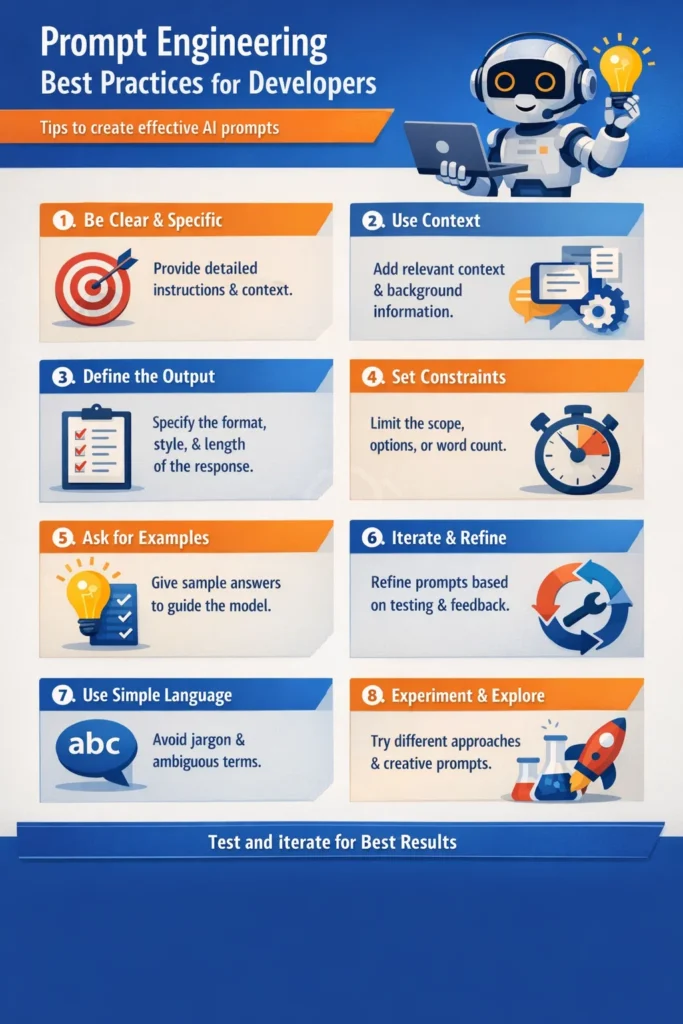
Be Explicit About Output Constraints
Models are probabilistic by nature. If you do not constrain outputs, they will vary.
Constraints should specify:
- Output format
- Allowed values
- Length expectations
- Tone or style limits
For example, asking for “a summary” produces wildly different results than asking for “a 3-bullet summary, each under 20 words.” The latter is not restrictive—it is stabilizing.
This principle aligns closely with patterns discussed in API rate limiting fundamentals, where explicit limits protect systems from unpredictable behavior.
Reduce Ambiguity with Structured Instructions
Ambiguity is the enemy of reliable prompts. Natural language is flexible, but flexibility increases variance.
Instead of:
“Explain this code simply”
Prefer:
“Explain the code at a high level for an intermediate developer, focusing on control flow and side effects. Avoid implementation details.”
Structured instructions guide the model’s reasoning path. They reduce interpretation drift and improve consistency across requests.
Use Examples, But Sparingly
Examples are powerful, but they must be used carefully.
Good examples:
- Demonstrate format
- Clarify intent
- Anchor edge cases
Bad examples:
- Overfit the model
- Introduce unintended patterns
- Inflate prompt size unnecessarily
In practice, one or two well-chosen examples outperform large collections. This is especially important when prompt size affects latency or cost.
If you are designing complex workflows, patterns similar to this appear in building custom GPT models for your team, where scope control is critical.
Prompt Engineering vs Fine-Tuning
Prompt engineering:
- Is fast to iterate
- Requires no training data
- Works well for logic, structure, and constraints
Fine-tuning:
- Encodes style and domain knowledge
- Requires curated datasets
- Is harder to change
In most applications, prompt engineering should come first. Fine-tuning is justified only when prompt complexity becomes unmanageable or when consistent stylistic output is required.
This mirrors architectural decisions discussed in REST vs GraphQL vs gRPC, where flexibility and structure must be balanced intentionally.
A Realistic Prompt Engineering Scenario
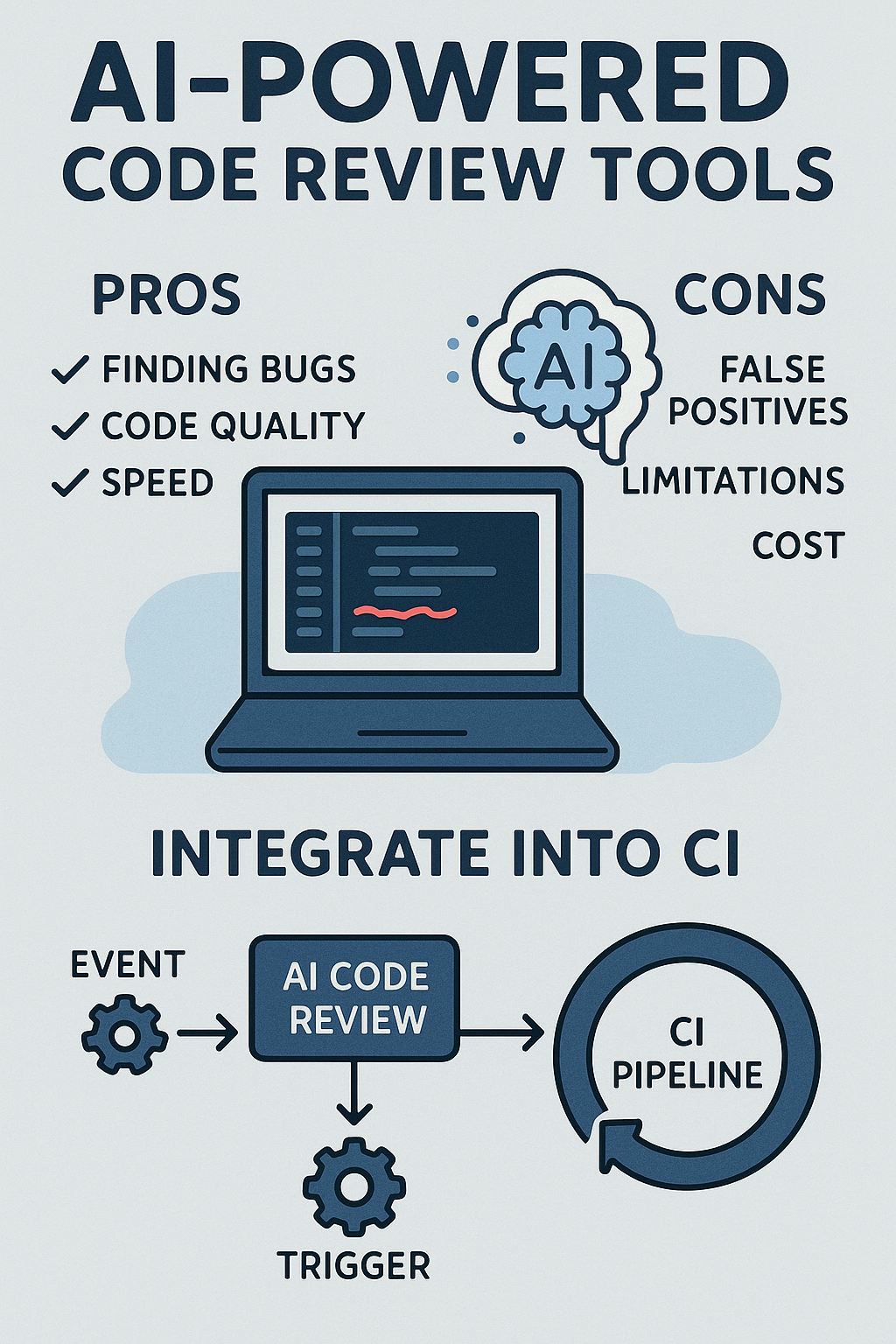
Consider an internal AI assistant that reviews pull requests. Early prompts ask the model to “review the code.” Results vary widely. Sometimes feedback is superficial, sometimes overly verbose.
By introducing explicit instructions—focus areas, severity levels, output structure—the same model becomes far more consistent. Review quality improves, and developers trust the output.
Nothing about the model changed. Only the prompt did. This is the real leverage of prompt engineering best practices.
Common Prompt Engineering Mistakes
A frequent mistake is adding more text instead of more structure. Longer prompts often increase confusion rather than clarity.
Another issue is relying on hidden assumptions. Models do not share your mental context. If a rule matters, it must be stated.
Finally, many teams never test prompts with adversarial or unexpected input. Prompts that work on happy paths often fail silently in production.
When Prompt Engineering Is Enough
- You need structured, repeatable outputs
- The domain logic is deterministic
- You want fast iteration and low cost
- Behavior must be explainable
When Prompt Engineering Is Not Enough
- Output style must be identical every time
- Domain knowledge is large and specialized
- Prompt complexity becomes unmanageable
- Latency constraints are strict
In those cases, prompt engineering should be combined with other techniques such as RAG or fine-tuning.
Prompt Engineering in Larger Systems
Prompt engineering does not exist in isolation. It interacts with retrieval, tools, streaming, and evaluation.
If you are already exploring system-level patterns, ideas from RAG from scratch apply directly. Retrieval reduces prompt size, tools reduce reasoning load, and prompts become orchestration rather than instruction dumps.
Conclusion
Prompt engineering best practices are about discipline. Clear structure, explicit constraints, and intentional design turn LLMs from unpredictable generators into reliable components.
A practical next step is to audit one existing prompt in your system. Remove ambiguity, add constraints, and document intent. Small changes compound quickly, and well-engineered prompts often outperform far more complex solutions.