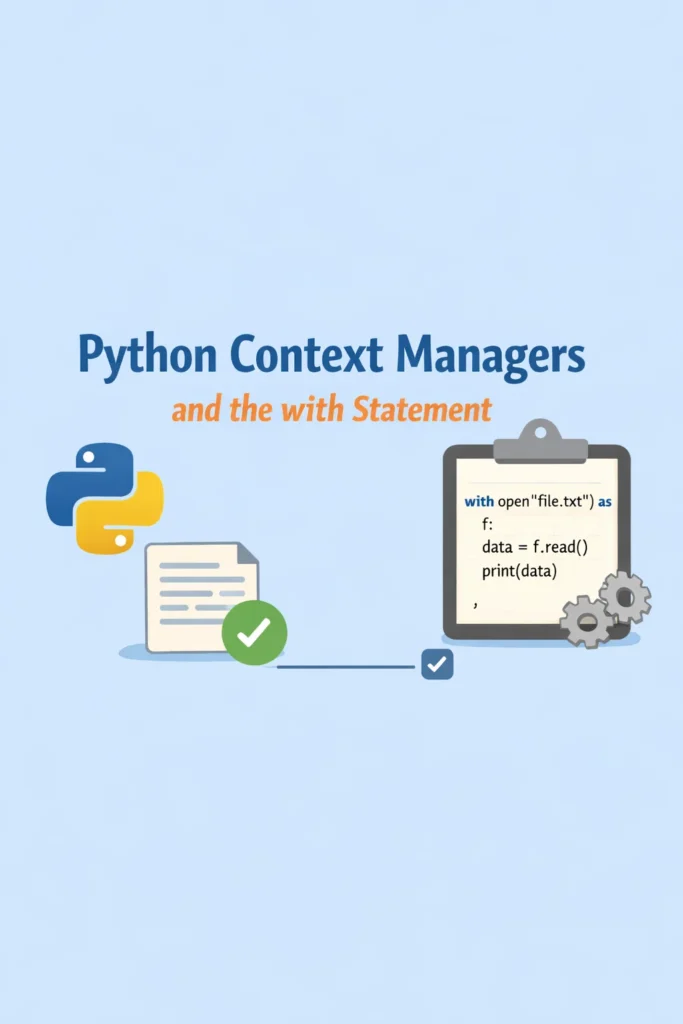
Python context managers provide a clean and reliable way to manage resources. If you have ever written with open("file.txt") as f:, you have already used python context managers. However, most developers stop at file handling and never explore the deeper architectural value of the with statement.
In this guide, we will break down how python context managers work internally, how to build your own, how exception handling behaves inside them, and how to use them safely in production systems.
What Are Python Context Managers?
Python context managers are objects that define setup and teardown behavior around a block of code.
In simple terms:
- Setup logic runs before the block executes.
- The main block runs.
- Cleanup logic runs automatically afterward, even if an exception occurs.
The with statement ensures that cleanup always happens.
That reliability is exactly why python context managers are preferred for file handling, database connections, transactions, locks, and network resources.
The Problem Python Context Managers Solve
Without context managers, resource management becomes fragile.
Consider manual handling:
file = open("data.txt")
try:
    content = file.read()
finally:
    file.close()
This works. However, it is verbose and easy to get wrong.
Now compare it to:
with open("data.txt") as file:
    content = file.read()
The with statement guarantees cleanup. Therefore, python context managers reduce boilerplate and eliminate common resource leaks.
How the with Statement Works Internally
The with statement calls two special methods:
__enter__()__exit__(exc_type, exc_value, traceback)
When execution reaches with:
__enter__()runs first.- The result of
__enter__()is assigned to the variable afteras. - The block executes.
__exit__()runs afterward, even if an exception occurred.
In simplified form:
manager = ContextManager()
value = manager.__enter__()
try:
    # block runs here
finally:
    manager.__exit__(...)
This predictable flow is what makes python context managers powerful and safe.
For full reference, see the official Python data model documentation.
Creating a Context Manager Using a Class
Here is a minimal custom implementation:
class MyContext:
    def __enter__(self):
        print("Entering context")
        return self

    def __exit__(self, exc_type, exc_value, traceback):
        print("Exiting context")
        return False
Usage:
with MyContext():
    print("Inside block")
__exit__ receives exception details. If it returns True, the exception is suppressed. If it returns False, the exception propagates normally.
This design gives python context managers precise control over error handling.
Using contextlib for Cleaner Context Managers
While class-based context managers work well, Python also provides contextlib for cleaner implementations.
from contextlib import contextmanager

@contextmanager
def my_context():
    print("Setup")
    try:
        yield
    finally:
        print("Cleanup")
Usage:
with my_context():
    print("Inside block")
This decorator-based approach is often more readable for simple setup and teardown logic.
See the official Python contextlib documentation for deeper reference.
Exception Handling in Python Context Managers
One of the most important aspects of python context managers is how they handle exceptions.
Inside __exit__, you receive:
- Exception type
- Exception instance
- Traceback
Example:
class SuppressError:
    def __enter__(self):
        return self

    def __exit__(self, exc_type, exc_value, traceback):
        return True
This suppresses any exception inside the block.
However, suppressing errors should be done carefully. In most cases, you want exceptions to propagate unless you have a strong reason to intercept them.
Async Context Managers
Modern Python systems often use asynchronous execution. Therefore, python context managers also support async variants.
Async context managers define:
__aenter__()__aexit__()
Example:
class AsyncContext:
    async def __aenter__(self):
        print("Entering async context")
        return self

    async def __aexit__(self, exc_type, exc_value, traceback):
        print("Exiting async context")
Usage:
async with AsyncContext():
    pass
If you are building async-heavy systems, this integrates naturally with patterns discussed in Async Programming in Python: asyncio vs Trio.
Real-World Production Use Cases
Database Transactions
Context managers are ideal for transaction handling.
For example, database transaction isolation and rollback logic benefit greatly from automatic cleanup. This connects directly to patterns explained in Database Transactions and Isolation Levels Explained.
ORM Session Management
In ORMs such as SQLAlchemy, sessions are often wrapped inside context managers to ensure proper closing and rollback. See SQLAlchemy Best Practices with PostgreSQL for architectural considerations.
Background Job Execution
Distributed task systems must manage resources carefully. Context managers help guarantee cleanup, which is especially important in systems like those discussed in Distributed Task Queues with Celery and RabbitMQ.
API Resource Handling
Frameworks like Django and FastAPI frequently rely on context-based patterns to manage request lifecycle behavior. For example, database connections and middleware-like patterns appear in Building REST APIs with Django REST Framework.
When to Use Python Context Managers
Use python context managers when:
- Managing files
- Handling database connections
- Controlling transactions
- Managing locks
- Allocating network resources
- Wrapping temporary configuration changes
They are ideal when setup and cleanup must always run reliably.
When Not to Use Python Context Managers
Avoid context managers when:
- No cleanup is required
- The lifecycle is complex and spans multiple independent stages
- Cleanup depends on external orchestration
In those situations, explicit lifecycle control may be clearer.
Common Mistakes
- Forgetting that
__exit__can suppress exceptions - Writing context managers that hide critical failures
- Mixing sync and async context managers incorrectly
- Overcomplicating simple resource usage
- Ignoring readability in decorator-based context managers
Most production issues with python context managers result from misunderstanding exception behavior.
Final Thoughts on Python Context Managers
Python context managers are more than a file-handling convenience. They are a disciplined way to enforce resource safety, transaction integrity, and lifecycle clarity.
Once you understand how __enter__ and __exit__ operate, you can design robust infrastructure layers that clean up automatically and behave predictably under failure.
The next practical step is simple: identify one repeated setup-and-teardown pattern in your codebase and refactor it into a well-designed context manager. That shift alone improves clarity and reliability immediately.