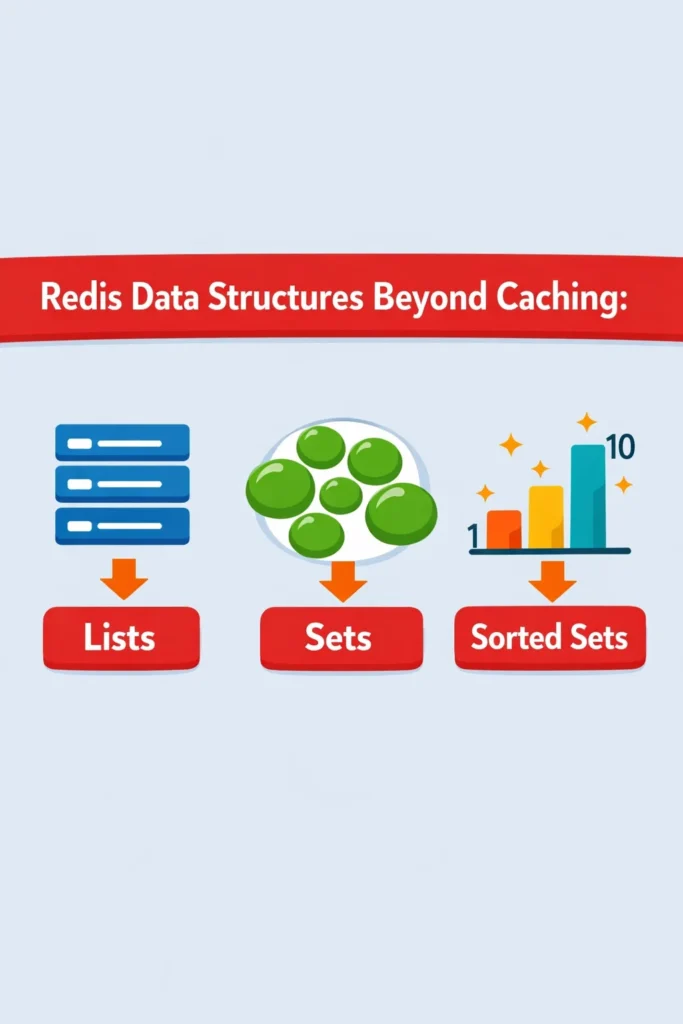
Redis is often introduced as a fast in-memory cache, but treating it only as a cache leaves most of its power unused. Redis is a data structure server, and its native structures enable patterns that are difficult or inefficient to implement elsewhere.
This article explores Redis data structures beyond caching, focusing on Lists, Sets, and Sorted Sets. You will learn what problems they solve, when they outperform traditional databases, and how they fit into real production systems.
Why Redis Is More Than a Cache
Caching is just one Redis use case. The real strength of Redis lies in atomic operations on specialized data structures. These operations run server-side, eliminate race conditions, and execute in predictable time.
This makes Redis ideal for:
- Real-time coordination
- Counters and limits
- Queues and pipelines
- Presence and ordering
If you have already used Redis for real-time messaging, patterns discussed in real-time notifications with Socket.IO and Redis rely heavily on these same structures.
Redis Lists: Queues, Streams, and Workflows
Redis Lists are ordered collections that support push and pop operations from both ends. This makes them a natural fit for queue-like behavior.
When Lists Shine
Lists are ideal when:
- Order matters
- Items are processed sequentially
- You need fast push/pop semantics
Common use cases include background job queues, event buffers, and message pipelines.
Because list operations are atomic, multiple producers and consumers can safely operate on the same list without locks.
Lists vs Traditional Queues
Unlike database-backed queues, Redis Lists operate entirely in memory and avoid transaction overhead. This makes them extremely fast and predictable.
However, Lists are not designed for complex querying or long-term persistence. They excel as coordination primitives, not as primary storage.
Redis Sets: Membership and Uniqueness
Redis Sets are unordered collections of unique values. They enforce uniqueness automatically and support fast membership checks.
What Sets Are Good At
Sets are perfect for:
- Tracking unique users
- Feature flags and toggles
- Presence systems
- Deduplication
Operations like union, intersection, and difference are built-in, allowing Redis to compute results that would otherwise require complex queries.
This makes Sets especially useful in access control and rate-limiting scenarios. If you are already implementing request limits, ideas from rate limiting strategies map naturally onto Redis Sets.
Sets vs Relational Constraints
In relational databases, enforcing uniqueness requires indexes and transactions. Redis Sets provide this guarantee implicitly and at much lower latency.
The trade-off is that Sets do not store additional attributes per member. They answer who is in, not who has what properties.
Redis Sorted Sets: Ordering with Meaning
Sorted Sets are one of Redis’s most powerful features. They associate each value with a score and maintain elements ordered by that score.
Why Sorted Sets Are Special
Sorted Sets enable:
- Leaderboards
- Priority queues
- Time-based ordering
- Ranking systems
Because ordering is maintained automatically, retrieving top-N or range-based results is efficient and predictable.
This capability is difficult to replicate efficiently with relational databases under high write rates.
Time as a Score
A common pattern is using timestamps as scores. This allows Redis to act as a time-ordered index, useful for:
- Expiring tasks
- Sliding windows
- Activity feeds
This pattern appears frequently in event-driven systems, similar to those discussed in event-driven microservices with Kafka, but at a much smaller operational scale.
Choosing the Right Data Structure
The most common Redis mistake is using the wrong structure for the problem.
A simple rule of thumb:
- Use Lists when order and sequential processing matter
- Use Sets when uniqueness and membership matter
- Use Sorted Sets when ranking or ordering by a score matters
Choosing correctly simplifies logic and improves performance.
Redis Data Structures in Real Systems
Redis data structures often sit between services rather than replacing databases.
Examples include:
- Coordinating background workers
- Enforcing rate limits before requests hit APIs
- Managing real-time state for connected users
- Maintaining short-lived ordering and rankings
This positioning mirrors architectural patterns discussed in API gateway patterns for SaaS applications, where Redis acts as a fast decision layer rather than a system of record.
Common Mistakes When Using Redis Data Structures
Several mistakes appear repeatedly:
- Using Redis as a primary database
- Ignoring memory growth
- Forgetting eviction and TTL strategies
- Modeling relational data inside Redis
Redis works best when its data structures are used intentionally and kept bounded.
Performance and Predictability
Redis data structure operations are designed to be fast, but not all operations are equal. Lists and Sets are typically O(1), while Sorted Sets involve logarithmic complexity.
Understanding these costs matters at scale, especially when Redis sits on critical paths.
This performance-awareness mindset aligns with ideas from profiling CPU and memory usage in backend applications, where predictability matters more than raw speed.
When Redis Is the Right Tool
Redis data structures are a great fit when:
- Latency must be extremely low
- Operations must be atomic
- Data is short-lived or derived
- Coordination matters more than persistence
When Redis Is the Wrong Tool
Redis is not ideal when:
- Data must be durable long-term
- Complex queries are required
- Strong relational constraints exist
- Memory usage cannot be bounded
In those cases, Redis should complement—not replace—other storage systems.
Redis in Modern Architectures
In modern systems, Redis often acts as the glue between components. It smooths spikes, coordinates work, and enables real-time features that would otherwise be costly to build.
Used correctly, Redis data structures reduce complexity instead of adding it.
Conclusion
Redis is not just a cache. Lists, Sets, and Sorted Sets unlock powerful patterns for coordination, ordering, and real-time behavior. The key is choosing the right structure for the problem and keeping Redis focused on what it does best.
A practical next step is to audit your current Redis usage. Identify places where simple key-value storage could be replaced with a native data structure. Small changes there often produce large improvements in clarity and performance.


2 Comments