Real-time applications need fast, simple message delivery. Redis Pub/Sub provides exactly that: lightweight publish–subscribe messaging with extremely low latency. When used correctly, it enables live updates, notifications, and coordination across services without complex infrastructure.
This article explains Redis Pub/Sub from a production perspective. You will learn how it works, what problems it solves well, where it breaks down, and how to decide whether it fits your real-time use case.
What Redis Pub/Sub Actually Is
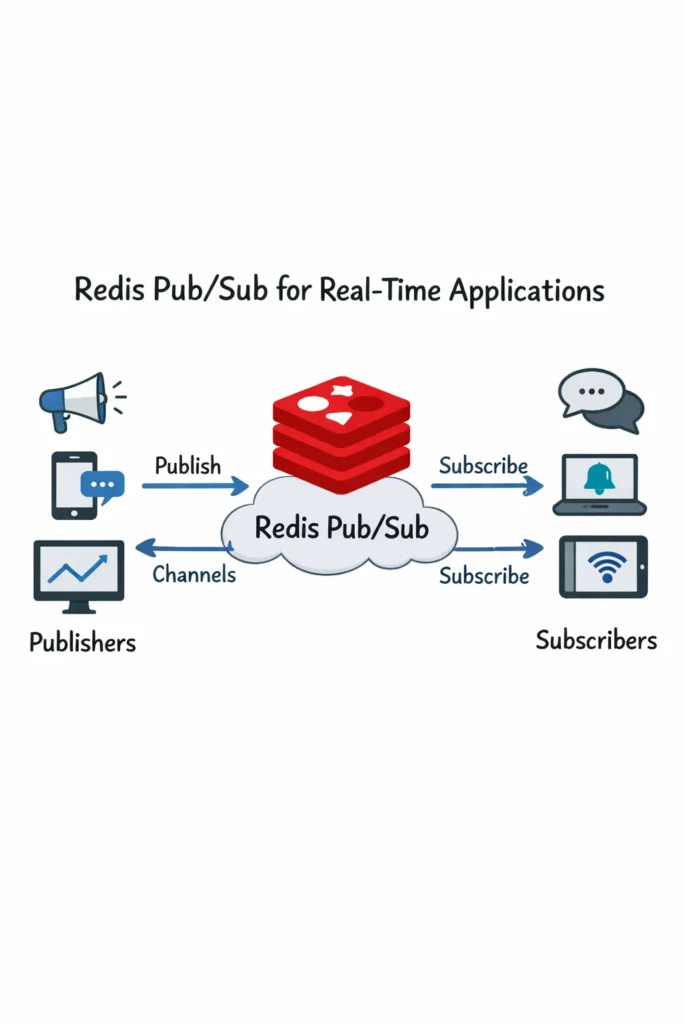
Redis Pub/Sub is a messaging pattern where publishers send messages to channels and subscribers receive messages from those channels. Messages are delivered immediately to all active subscribers.
There is no persistence, no replay, and no acknowledgment. If a subscriber is disconnected, the message is lost.
This simplicity is the core strength of Redis Pub/Sub. It is designed for ephemeral, real-time communication, not durable messaging.
If you are already familiar with Redis beyond caching, ideas from Redis data structures beyond caching help frame where Pub/Sub fits in the Redis ecosystem.
How Redis Pub/Sub Works Internally
Redis maintains an in-memory mapping of channels to subscribers. When a message is published, Redis pushes it directly to all connected clients subscribed to that channel.
There is no queue and no storage layer. Delivery happens synchronously as part of the publish operation, which means messages are delivered only to clients that are actively connected at publish time. For command semantics, delivery guarantees, and protocol details, see the Redis Pub/Sub official documentation.
This design keeps latency extremely low, but it also means Redis Pub/Sub offers at-most-once delivery. Reliability must be handled elsewhere if required.
When Redis Pub/Sub Is a Good Fit
Redis Pub/Sub works best when:
- Messages are transient
- Low latency matters more than durability
- Subscribers are usually online
- Ordering matters only per connection
Common use cases include live notifications, chat typing indicators, presence updates, and real-time UI refreshes.
These patterns appear frequently in systems built with WebSockets. If you are already implementing real-time delivery, concepts from real-time APIs with WebSockets and server-sent events map naturally onto Redis Pub/Sub as a backend transport.
Redis Pub/Sub vs Message Queues
A common mistake is using Redis Pub/Sub as a message queue.
Message queues provide durability, acknowledgments, retries, and backpressure. Redis Pub/Sub provides none of these.
Use Redis Pub/Sub when messages are signals, not tasks. For example, “invalidate cache,” “user status changed,” or “new message arrived.”
If you need guaranteed processing or task distribution, Pub/Sub is the wrong tool.
This distinction mirrors architectural decisions discussed in event-driven microservices with Kafka, where durability and replay are first-class concerns.
Redis Pub/Sub and WebSocket Backends
One of the most common Redis Pub/Sub patterns is pairing it with WebSocket servers.
In this setup:
- WebSocket servers subscribe to Redis channels
- Backend services publish events to Redis
- Connected clients receive updates instantly
This allows horizontal scaling. Any backend instance can publish an event, and all connected clients receive it regardless of which server they are connected to.
If you are building notification systems, similar ideas appear in real-time notifications with Socket.IO and Redis, where Pub/Sub acts as the broadcast layer.
Channel Design and Naming
Channel design matters more than it first appears.
Poorly structured channels lead to unnecessary traffic and wasted processing. Good channel design scopes messages narrowly and avoids global broadcasts unless required.
Common strategies include:
- Per-entity channels (e.g. user or room scoped)
- Event-type channels
- Hierarchical naming conventions
Clear naming improves observability and makes debugging far easier.
Scaling Redis Pub/Sub
Redis Pub/Sub scales well vertically but has limits horizontally.
Because messages are pushed synchronously, high fan-out can block Redis if subscribers are slow. Additionally, Pub/Sub traffic is not persisted or partitioned.
For moderate-scale real-time systems, this is acceptable. For very high throughput or large fan-out, alternatives may be needed.
These scalability considerations align with ideas from monitoring and logging in microservices, where visibility into system behavior is essential.
Redis Pub/Sub vs Redis Streams
Redis Streams are often confused with Pub/Sub, but they solve different problems.
Pub/Sub:
- Fire-and-forget
- No persistence
- No replay
- Extremely low latency
Streams:
- Persistent
- Consumer groups
- Replayable
- Higher operational complexity
If consumers must never miss messages, Streams are the better choice. If messages are transient and time-sensitive, Pub/Sub is often simpler and faster.
A Realistic Pub/Sub Use Case
Consider a dashboard showing live system metrics.
Backend services publish metric updates to Redis channels. Frontend servers subscribe and push updates to connected clients in real time.
If a client disconnects briefly, missing a few updates is acceptable. The next update replaces the old state anyway.
This is exactly the type of scenario where Redis Pub/Sub shines.
Common Redis Pub/Sub Mistakes
Several mistakes appear repeatedly:
- Assuming messages are durable
- Publishing large payloads
- Broadcasting everything on one channel
- Ignoring slow subscribers
Each of these reduces reliability or performance.
When Redis Pub/Sub Is the Right Choice
Redis Pub/Sub is a strong fit when:
- Messages are short-lived
- Latency must be minimal
- Simplicity matters
- Delivery guarantees are relaxed
When Redis Pub/Sub Is the Wrong Choice
Avoid Redis Pub/Sub when:
- Messages must never be lost
- Consumers process messages asynchronously
- Backpressure and retries are required
- Audit or replay is necessary
In those cases, use streams or a dedicated message broker.
Redis Pub/Sub in Modern Architectures
Redis Pub/Sub often acts as a signal bus inside modern systems. It connects services, triggers updates, and keeps state in sync without heavy coordination.
Used intentionally, it reduces coupling and improves responsiveness.
Conclusion
Redis Pub/Sub is not a queue, and it is not a log. It is a fast, ephemeral messaging mechanism designed for real-time signaling. When used for the right problems, it is simple, reliable, and extremely effective.
A practical next step is to audit your real-time flows. Identify which messages are signals and which require durability. Redis Pub/Sub fits the former perfectly—and trying to stretch it into the latter is where most systems run into trouble.