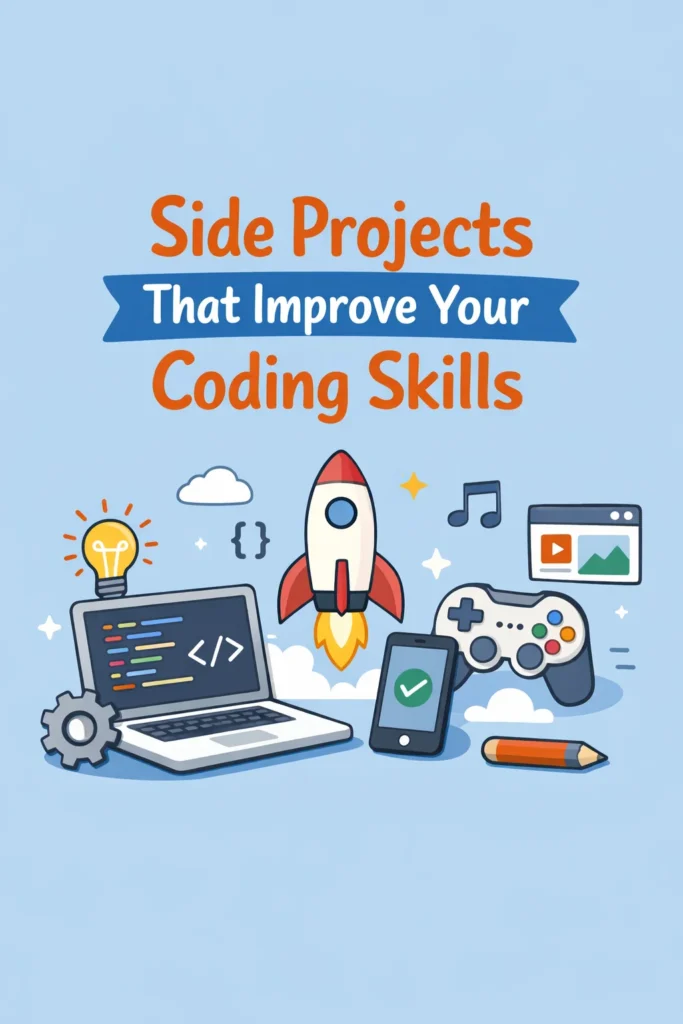
Side projects can dramatically improve your coding skills—if you choose the right ones. Many developers start projects full of motivation but abandon them because they lack direction or challenge.
In this guide, you will learn which types of side projects actually accelerate growth, how to choose them strategically, and how to avoid wasting time on low-impact ideas.
Why Side Projects Matter
Side projects give you something daily work sometimes does not: freedom.
They allow you to:
- Explore new technologies
- Experiment without production pressure
- Practice architecture decisions
- Solve real problems end to end
More importantly, they help you develop independent thinking—one of the strongest signals of senior growth, as discussed in Transitioning from Junior to Senior Developer.
Build Something Slightly Above Your Comfort Zone
The best side projects stretch you—but do not overwhelm you.
Choose projects that:
- Require one new concept
- Push you to design, not just code
- Expose you to unfamiliar constraints
For example, if you are a frontend developer, build a small backend API. If you focus on mobile, try designing database schemas and thinking about performance.
Growth happens at the edge of competence.
Rebuild a Simple Product from Scratch
Rebuilding familiar tools improves understanding deeply.
Good examples include:
- A basic task manager
- A URL shortener
- A chat app
- A note-taking tool
While these ideas sound simple, implementing authentication, validation, caching, and state management adds real complexity.
Projects like these connect well with structured backend thinking described in Scalable Express.js Project Structure.
Create a Small API with Real Constraints
APIs teach practical engineering discipline.
A valuable API project should include:
- Authentication
- Rate limiting
- Validation
- Error handling
- Logging
Instead of just returning JSON, think about security and performance trade-offs. Topics like those explored in API Rate Limiting 101 become far clearer when implemented hands-on.
Build a Real-Time Feature
Real-time systems force you to think differently.
You could build:
- A live chat
- A collaborative document editor
- A real-time dashboard
These projects introduce concurrency, event handling, and synchronization challenges. They also connect naturally to concepts explained in Real-Time APIs: WebSockets vs Server-Sent Events.
Focus on Architecture, Not Just Features
Feature-heavy projects often hide weak structure.
Instead, design your side project intentionally:
- Use clean folder structures
- Separate concerns clearly
- Add basic tests
- Document decisions
This habit strengthens long-term maintainability and mirrors practices discussed in Clean Code in Flutter.
Improve Performance Intentionally
Many side projects ignore performance completely.
Challenge yourself to:
- Analyze time complexity
- Optimize database queries
- Reduce unnecessary re-renders
- Add caching
You will better understand system bottlenecks and trade-offs, which align with ideas in PostgreSQL Performance Tuning: Indexes, EXPLAIN, and Query Optimization.
Build Tools for Yourself
Personal pain makes the best project ideas.
Ask yourself:
- What repetitive task frustrates me?
- What small automation could save time?
- What tool do I wish existed?
When you solve your own problem, motivation increases dramatically.
Contribute to Open Source as a Side Project
Open source can function as a structured side project.
It exposes you to:
- Large codebases
- Real code review
- Production-level constraints
If you want structured collaboration experience, explore ideas in Contributing to Open Source: A Beginner’s Guide.
Avoid Tutorial-Only Projects
Tutorials help at the beginning. However, copying projects step by step does not build independent problem-solving.
Instead:
- Modify tutorial projects significantly
- Add new features on your own
- Refactor architecture deliberately
Real growth begins when you make decisions without step-by-step guidance.
Keep Scope Small and Finish
Many developers fail not because of difficulty, but because of scope creep.
Better strategy:
- Ship version 1 quickly
- Improve incrementally
- Resist endless rewrites
Finishing projects builds confidence and momentum.
Document Your Work Publicly
Side projects become more powerful when visible.
You can:
- Write short technical blog posts
- Record lessons learned
- Share GitHub repositories
- Add projects to your portfolio
This strengthens your public profile and supports career growth, similar to strategies in Building a Developer Portfolio That Gets Noticed.
A Practical Side Project Roadmap
If you want structure, try this progression:
- Month 1: Build a simple CRUD app
- Month 2: Add authentication and validation
- Month 3: Introduce real-time updates
- Month 4: Refactor for clean architecture and performance
Each stage builds new layers of skill.
Side Projects Should Be Intentional
Random coding does not guarantee improvement. Strategic side projects do.
Choose projects that:
- Teach a new concept
- Strengthen fundamentals
- Improve architectural thinking
- Produce something tangible
Conclusion
Side projects that improve your coding skills are not about flashy ideas. They are about deliberate practice, structured experimentation, and finishing what you start.
A practical next step is to define one small project that challenges a single weak area in your skillset. Build it fully, refine it once, and move forward. Consistent execution beats ambitious ideas every time.