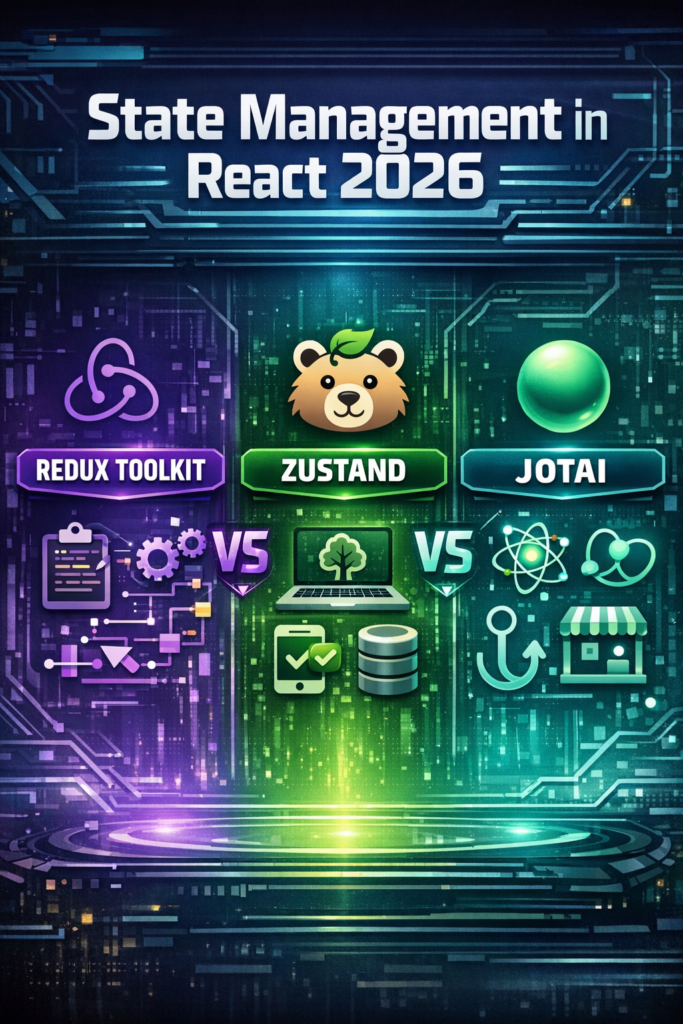
State management in React has evolved significantly. In 2026, choosing the “best” library depends less on trends and more on what kind of state your application manages: UI state, server data, authentication, cross-feature coordination, or complex derived values.
Redux Toolkit, Zustand, and Jotai all solve real problems, but they do so using very different mental models. Those differences directly affect scalability, debuggability, and long-term maintainability.
This guide explores state management in React 2026 with practical scenarios, real code, and clear trade-offs.
Before Choosing a Library, Classify Your State
Most state-management issues come from placing the wrong state in the wrong layer.
Server state (remote data)
Server state includes API-driven data such as lists, dashboards, billing details, and search results. This data benefits from caching, refetching, invalidation, and background updates.
In modern React apps, this state rarely belongs in a generic global store. Redux Toolkit strongly encourages separating it via RTK Query, as explained in the Redux Toolkit documentation.
UI state (local interaction)
Modals, dropdowns, tabs, and loading flags usually belong close to components. Global state is often unnecessary here.
App state (shared client state)
Authentication state, feature flags, selected workspace, and multi-step flows often require shared client-side storage.
Derived state (computed values)
Derived state should be calculated on demand whenever possible. Storing it leads to synchronization bugs and unnecessary complexity.
If you’re adopting server-first React patterns, React Server Components explained show how much client-side state can be eliminated entirely.
Redux Toolkit: Predictable Structure for Large Applications
Redux Toolkit (RTK) is the officially recommended way to write Redux logic. It exists to reduce boilerplate while preserving Redux’s strengths: explicit updates and predictable state flow.
What Redux Toolkit Optimizes For
Redux Toolkit is designed for:
- Predictable data flow
- Centralized state with clear ownership
- Strong conventions across teams
- Excellent debugging and tooling
For large or long-lived applications, this structure often outweighs minimalism.
Redux Toolkit in 2026: RTK + RTK Query
In modern React apps, Redux Toolkit usually handles:
- Client state (auth, flags, UI flows)
- Server state via RTK Query
RTK Query removes the need to manually manage loading, caching, and refetch logic, preventing many common Redux anti-patterns.
Practical Redux Toolkit Example
import { createSlice, PayloadAction } from "@reduxjs/toolkit";

type AuthState = { token: string | null };

const initialState: AuthState = { token: null };

const authSlice = createSlice({
  name: "auth",
  initialState,
  reducers: {
    setToken(state, action: PayloadAction<string | null>) {
      state.token = action.payload;
    },
  },
});

export const { setToken } = authSlice.actions;
export default authSlice.reducer;
This pattern scales well when many developers touch the same state.
Strengths
- Strong conventions
- Excellent DevTools
- Mature ecosystem
Limitations
- More setup than lightweight solutions
- Can feel heavy for small apps
Redux Toolkit is powerful when structure is a requirement, not a burden.
Zustand: Lightweight Shared State Without Ceremony
Zustand focuses on simplicity. It provides shared state with minimal boilerplate and a small API surface, as described in the Zustand documentation.
What Zustand Optimizes For
Zustand works best when you need:
- Fast setup
- Feature-level shared state
- Minimal abstractions
It is especially effective for dashboards, internal tools, and UI-heavy applications.
Practical Zustand Example
import { create } from "zustand";

type AuthStore = {
  token: string | null;
  setToken: (token: string | null) => void;
};

export const useAuthStore = create<AuthStore>((set) => ({
  token: null,
  setToken: (token) => set({ token }),
}));
The simplicity is intentional—but it requires discipline.
Scaling Zustand Cleanly
Zustand scales best when:
- Stores are scoped per feature
- One global mega-store is avoided
- Store actions act as a public API
This aligns well with ideas discussed in Clean Code in Flutter.
Strengths
- Minimal setup
- Easy to reason about
- Good performance by default
Limitations
- Few enforced conventions
- Easy to misuse in large teams
Jotai: Atomic State With Fine-Grained Updates
Jotai uses an atomic model where state is built from small, independent units called atoms. Components subscribe only to what they need, as explained in the Jotai documentation.
What Jotai Optimizes For
Jotai shines when:
- UI state is complex and interconnected
- Fine-grained reactivity is important
- Global stores feel too rigid
Practical Jotai Example
import { atom, useAtom } from "jotai";

const tokenAtom = atom<string | null>(null);

export function useAuthToken() {
  return useAtom(tokenAtom);
}
Atoms can be composed, derived, and grouped as the app grows.
Strengths
- Very fine-grained updates
- Natural fit with React composition
Limitations
- Harder to visualize global state
- Needs conventions to avoid fragmentation
Performance: What Actually Matters
Performance problems usually come from patterns, not libraries.
- Redux Toolkit performs well with proper selectors
- Zustand minimizes re-renders by default
- Jotai reduces updates through atomic subscriptions
The same “measure before you optimize” principle applies here, just like in Flutter performance optimization tips.
Choosing the Right Tool
Redux Toolkit is a strong choice when:
- The app is large and maintained long-term
- Many developers share the same state
- Predictability and tooling matter
Zustand works best if:
- You want minimal setup
- State is shared but not deeply complex
- Feature-level stores are sufficient
Jotai makes sense when:
- UI state is complex and interconnected
- Fine-grained control over updates is important
Common Mistakes
- Storing server data in client-only global state
- Choosing Redux by habit for small apps
- Letting Zustand stores grow without structure
- Creating many atoms without clear ownership
Final Thoughts
State management in React 2026 is about matching the tool to the type of state, not picking a single winner.
Redux Toolkit, Zustand, and Jotai each excel in different scenarios. Classify your state first, then choose the simplest solution that can grow with your application.


1 Comment