Introduction
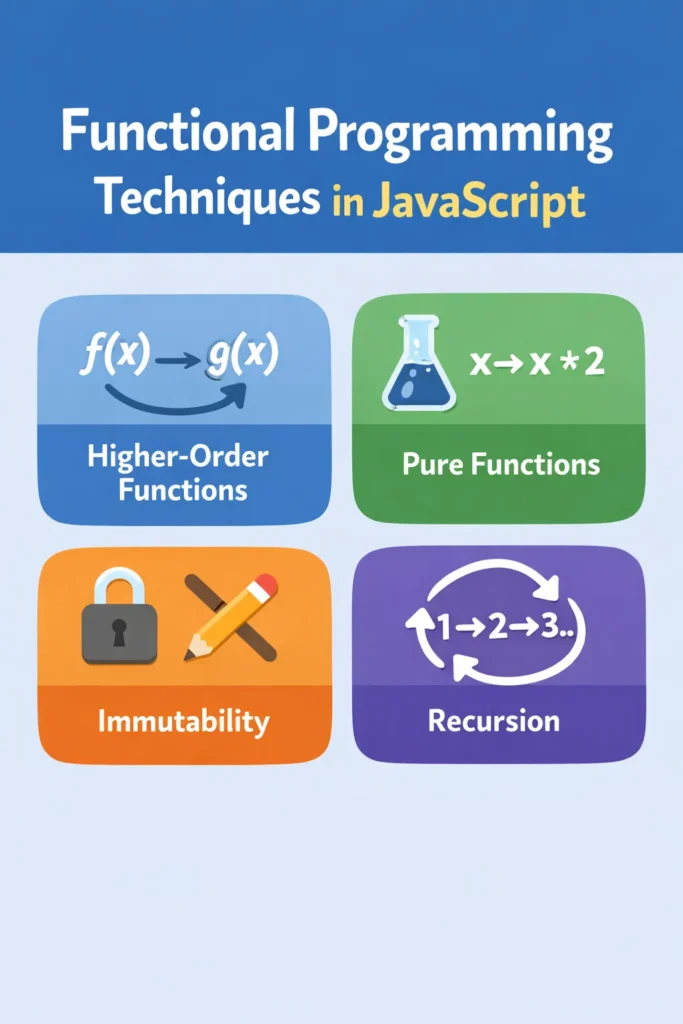
As JavaScript applications grow in complexity, managing state, handling asynchronous operations, and maintaining predictable behavior becomes increasingly challenging. Functional programming (FP) offers a powerful set of techniques that focus on predictable behavior, reusable logic, and fewer side effects. Instead of changing data in place, FP encourages transforming data through pure functions that produce consistent outputs. While JavaScript is a multi-paradigm language, functional techniques have become central to modern development, powering frameworks like React and Redux. In this comprehensive guide, you will learn core functional programming techniques in JavaScript, from pure functions and immutability to advanced patterns like composition, currying, and functors, seeing how to apply them in real projects to write cleaner, safer, and more maintainable code.
Why Functional Programming Matters in JavaScript
JavaScript’s flexibility allows multiple programming paradigms. However, functional techniques often lead to clearer logic, fewer bugs, and more testable code.
Key Benefits
- Predictable behavior: Pure functions always return the same output for the same input
- Easier testing: No external dependencies to mock or setup
- Better composability: Small functions combine into complex behavior
- Reduced side effects: Bugs from unexpected mutations disappear
- Improved readability: Declarative code expresses intent clearly
- Parallelization friendly: Immutable data enables safe concurrent processing
Many modern JavaScript libraries and frameworks rely heavily on functional patterns, making these skills essential for contemporary development.
Pure Functions: The Foundation
A pure function always returns the same output for the same input and causes no side effects. This predictability makes pure functions the building blocks of functional programming.
Pure Function Examples
// Pure: Same input always produces same output
function add(a, b) {
  return a + b;
}

function calculateTax(price, rate) {
  return price * rate;
}

function formatName(firstName, lastName) {
  return `${firstName} ${lastName}`;
}

// Pure with objects (returns new object)
function updateUser(user, updates) {
  return { ...user, ...updates };
}
Impure Function Examples
// Impure: Depends on external state
let taxRate = 0.1;
function calculateTax(price) {
  return price * taxRate; // Depends on external variable
}

// Impure: Modifies external state
let total = 0;
function addToTotal(amount) {
  total += amount; // Side effect
  return total;
}

// Impure: Non-deterministic
function getRandomGreeting(name) {
  const greetings = ['Hello', 'Hi', 'Hey'];
  return `${greetings[Math.floor(Math.random() * 3)]}, ${name}`;
}
Referential Transparency
Pure functions exhibit referential transparency—you can replace a function call with its result without changing program behavior:
// These are equivalent when add is pure
const result1 = add(2, 3) + add(2, 3);
const result2 = 5 + 5;
const result3 = 10;
Immutability: Never Mutate Data
Immutability means data is not changed after creation. Instead of modifying existing data, you create new data structures with the changes applied.
Immutable Object Updates
// Mutable (avoid this)
const user = { name: 'Alice', age: 25 };
user.age = 26; // Mutation

// Immutable (prefer this)
const user = { name: 'Alice', age: 25 };
const updatedUser = { ...user, age: 26 }; // New object

// Nested updates
const state = {
  user: { name: 'Alice', preferences: { theme: 'light' } },
  settings: { notifications: true }
};

const newState = {
  ...state,
  user: {
    ...state.user,
    preferences: {
      ...state.user.preferences,
      theme: 'dark'
    }
  }
};
Immutable Array Operations
const numbers = [1, 2, 3, 4, 5];

// Mutating methods (avoid)
numbers.push(6);      // Modifies original
numbers.splice(0, 1); // Modifies original
numbers.sort();       // Modifies original

// Immutable alternatives
const withSix = [...numbers, 6];           // Add to end
const withZero = [0, ...numbers];          // Add to start
const withoutFirst = numbers.slice(1);     // Remove first
const sorted = [...numbers].sort();        // Sort copy
const updated = numbers.map((n, i) => i === 2 ? 99 : n); // Update at index
const filtered = numbers.filter(n => n !== 3);           // Remove by value
Object.freeze for Enforcement
const config = Object.freeze({
  apiUrl: 'https://api.example.com',
  timeout: 5000
});

config.apiUrl = 'changed'; // Silently fails (or throws in strict mode)
console.log(config.apiUrl); // Still 'https://api.example.com'

// Note: freeze is shallow
const deep = Object.freeze({ nested: { value: 1 } });
deep.nested.value = 2; // This works! Nested object not frozen
Higher-Order Functions
A higher-order function either takes a function as an argument, returns a function, or both. This pattern enables powerful abstractions and code reuse.
Functions as Arguments
// Higher-order: accepts function argument
function repeat(times, action) {
  for (let i = 0; i < times; i++) {
    action(i);
  }
}

repeat(3, console.log); // 0, 1, 2
repeat(3, i => console.log(`Iteration ${i}`));
Functions Returning Functions
// Higher-order: returns a function
function createMultiplier(factor) {
  return function(number) {
    return number * factor;
  };
}

const double = createMultiplier(2);
const triple = createMultiplier(3);

console.log(double(5));  // 10
console.log(triple(5));  // 15

// Practical example: logging wrapper
function withLogging(fn, label) {
  return function(...args) {
    console.log(`[${label}] Called with:`, args);
    const result = fn(...args);
    console.log(`[${label}] Returned:`, result);
    return result;
  };
}

const loggedAdd = withLogging(add, 'add');
loggedAdd(2, 3); // Logs call and result
Practical Higher-Order Functions
// Memoization
function memoize(fn) {
  const cache = new Map();
  return function(...args) {
    const key = JSON.stringify(args);
    if (cache.has(key)) {
      return cache.get(key);
    }
    const result = fn(...args);
    cache.set(key, result);
    return result;
  };
}

const expensiveCalculation = memoize((n) => {
  console.log('Computing...');
  return n * n;
});

expensiveCalculation(5); // Computing... 25
expensiveCalculation(5); // 25 (cached, no log)

// Debounce
function debounce(fn, delay) {
  let timeoutId;
  return function(...args) {
    clearTimeout(timeoutId);
    timeoutId = setTimeout(() => fn(...args), delay);
  };
}

const debouncedSearch = debounce(query => {
  console.log('Searching:', query);
}, 300);
Array Methods as Functional Tools
JavaScript’s array methods embody functional principles. They transform data without mutation and chain elegantly.
map: Transform Elements
const users = [
  { name: 'Alice', age: 25 },
  { name: 'Bob', age: 30 },
  { name: 'Charlie', age: 35 }
];

// Extract names
const names = users.map(user => user.name);
// ['Alice', 'Bob', 'Charlie']

// Transform structure
const formatted = users.map(user => ({
  displayName: user.name.toUpperCase(),
  isAdult: user.age >= 18
}));
filter: Select Elements
// Filter by condition
const adults = users.filter(user => user.age >= 18);
const seniors = users.filter(user => user.age >= 65);

// Remove falsy values
const values = [0, 1, '', 'hello', null, undefined, false, true];
const truthy = values.filter(Boolean);
// [1, 'hello', true]
reduce: Accumulate Values
const orders = [
  { product: 'Keyboard', price: 100 },
  { product: 'Mouse', price: 50 },
  { product: 'Monitor', price: 300 }
];

// Sum prices
const total = orders.reduce((sum, order) => sum + order.price, 0);
// 450

// Group by property
const transactions = [
  { type: 'income', amount: 1000 },
  { type: 'expense', amount: 200 },
  { type: 'income', amount: 500 },
  { type: 'expense', amount: 100 }
];

const grouped = transactions.reduce((acc, tx) => {
  acc[tx.type] = acc[tx.type] || [];
  acc[tx.type].push(tx);
  return acc;
}, {});

// Build object from array
const keyValuePairs = [['a', 1], ['b', 2], ['c', 3]];
const obj = keyValuePairs.reduce((acc, [key, value]) => {
  acc[key] = value;
  return acc;
}, {});
// { a: 1, b: 2, c: 3 }
Chaining Methods
const products = [
  { name: 'Laptop', price: 1200, inStock: true },
  { name: 'Phone', price: 800, inStock: false },
  { name: 'Tablet', price: 500, inStock: true },
  { name: 'Watch', price: 300, inStock: true }
];

// Chain operations
const affordableInStock = products
  .filter(p => p.inStock)
  .filter(p => p.price < 1000)
  .map(p => p.name)
  .sort();
// ['Tablet', 'Watch']
Function Composition
Function composition combines simple functions into complex operations, building pipelines that transform data step by step.
Manual Composition
const toUpperCase = str => str.toUpperCase();
const trim = str => str.trim();
const addExclamation = str => `${str}!`;

// Manual composition (read right to left)
const shout = str => addExclamation(toUpperCase(trim(str)));

console.log(shout('  hello world  ')); // 'HELLO WORLD!'
Compose and Pipe Functions
// Compose: right to left
const compose = (...fns) => x => fns.reduceRight((v, f) => f(v), x);

const shout = compose(addExclamation, toUpperCase, trim);

// Pipe: left to right (more intuitive)
const pipe = (...fns) => x => fns.reduce((v, f) => f(v), x);

const process = pipe(
  trim,
  toUpperCase,
  addExclamation
);

console.log(process('  hello  ')); // 'HELLO!'
Practical Composition Example
// Data processing pipeline
const parseJSON = str => JSON.parse(str);
const extractUsers = data => data.users;
const filterActive = users => users.filter(u => u.active);
const sortByName = users => [...users].sort((a, b) => a.name.localeCompare(b.name));
const formatNames = users => users.map(u => `${u.name} (${u.email})`);

const processUserData = pipe(
  parseJSON,
  extractUsers,
  filterActive,
  sortByName,
  formatNames
);

const result = processUserData('{"users":[{"name":"Bob","email":"bob@test.com","active":true}]}');
Currying: Partial Application
Currying transforms a function with multiple arguments into a sequence of functions, each taking a single argument. This enables partial application and more flexible function reuse.
// Regular function
function add(a, b, c) {
  return a + b + c;
}

// Curried version
const curriedAdd = a => b => c => a + b + c;

curriedAdd(1)(2)(3); // 6

// Partial application
const add5 = curriedAdd(5);
const add5And10 = add5(10);
add5And10(3); // 18
Auto-Curry Helper
function curry(fn) {
  return function curried(...args) {
    if (args.length >= fn.length) {
      return fn(...args);
    }
    return (...more) => curried(...args, ...more);
  };
}

const multiply = curry((a, b, c) => a * b * c);

multiply(2)(3)(4);     // 24
multiply(2, 3)(4);     // 24
multiply(2)(3, 4);     // 24
multiply(2, 3, 4);     // 24
Practical Currying Examples
// Configurable logger
const log = level => message => data =>
  console.log(`[${level}] ${message}:`, data);

const logInfo = log('INFO');
const logError = log('ERROR');

logInfo('User logged in')({ userId: 123 });
logError('Failed to fetch')({ error: 'Network timeout' });

// API request builder
const request = method => endpoint => data =>
  fetch(endpoint, { method, body: JSON.stringify(data) });

const post = request('POST');
const get = request('GET');

const createUser = post('/api/users');
const fetchUsers = get('/api/users');
Functors and Monads (Simplified)
Functors and monads provide containers that allow you to apply functions to wrapped values. While JavaScript lacks native support, the patterns are powerful.
Maybe Functor for Null Safety
class Maybe {
  constructor(value) {
    this.value = value;
  }

  static of(value) {
    return new Maybe(value);
  }

  isNothing() {
    return this.value === null || this.value === undefined;
  }

  map(fn) {
    return this.isNothing() ? this : Maybe.of(fn(this.value));
  }

  getOrElse(defaultValue) {
    return this.isNothing() ? defaultValue : this.value;
  }
}

// Usage
const user = { name: 'Alice', address: { city: 'NYC' } };

const city = Maybe.of(user)
  .map(u => u.address)
  .map(a => a.city)
  .getOrElse('Unknown');

console.log(city); // 'NYC'

// Handles null safely
const noUser = null;
const defaultCity = Maybe.of(noUser)
  .map(u => u.address)
  .map(a => a.city)
  .getOrElse('Unknown');

console.log(defaultCity); // 'Unknown'
Either for Error Handling
class Either {
  constructor(value, isRight = true) {
    this.value = value;
    this.isRight = isRight;
  }

  static right(value) {
    return new Either(value, true);
  }

  static left(value) {
    return new Either(value, false);
  }

  map(fn) {
    return this.isRight ? Either.right(fn(this.value)) : this;
  }

  fold(leftFn, rightFn) {
    return this.isRight ? rightFn(this.value) : leftFn(this.value);
  }
}

// Usage
function divide(a, b) {
  return b === 0
    ? Either.left('Cannot divide by zero')
    : Either.right(a / b);
}

divide(10, 2)
  .map(x => x * 2)
  .fold(
    error => console.log('Error:', error),
    result => console.log('Result:', result)
  );
// Result: 10
Common Mistakes to Avoid
Over-Abstracting Too Early
Creating too many tiny functions hurts readability. Balance abstraction with clarity. If a function is used once and is simple, inline it.
Ignoring Performance Costs
Immutability creates new objects and arrays. For hot paths or large data, this overhead matters. Use structural sharing libraries like Immutable.js or Immer when needed.
Forcing FP Everywhere
Functional programming is a tool, not a religion. Some problems are better solved imperatively. Use FP where it improves code quality.
Mutating Inside reduce
// Wrong: Mutating accumulator
const grouped = items.reduce((acc, item) => {
  acc[item.type].push(item); // Mutation!
  return acc;
}, {});

// Right: Return new structure
const grouped = items.reduce((acc, item) => ({
  ...acc,
  [item.type]: [...(acc[item.type] || []), item]
}), {});
Forgetting Initial Values in reduce
Always provide an initial value to reduce to avoid unexpected behavior with empty arrays.
Functional Programming in Modern Frameworks
- React: Pure components, immutable state, hooks as composition
- Redux: Pure reducers, immutable state updates, action creators
- RxJS: Functional reactive streams with operators
- Ramda/Lodash-fp: Utility libraries designed for FP
Conclusion
Functional programming techniques help JavaScript developers write clearer, safer, and more predictable code. By using pure functions, embracing immutability, mastering higher-order functions, and composing operations through pipes and currying, you can reduce bugs, improve testability, and build more maintainable applications. These patterns are not just academic—they power modern frameworks and enable scalable architectures. If you want to strengthen your JavaScript foundations, read Modern ECMAScript Features You Might Have Missed. For advanced type safety that complements FP, see Advanced TypeScript Types & Generics: Utility Types Explained. For deeper exploration, visit the Functional-Light JavaScript book and the Ramda documentation. With balanced application, functional programming becomes a powerful approach in modern JavaScript development.



1 Comment