If you have shipped an LLM feature to real users, you already know the uncomfortable part: the model is the one component in your stack that can return something completely different tomorrow for the same input. Guardrails for LLMs are the deterministic code you wrap around that unpredictability so a bad generation becomes a handled error instead of a support ticket. This guide is for backend and full-stack engineers who have a working prototype and now need it to survive contact with adversarial users, malformed data, and compliance review.
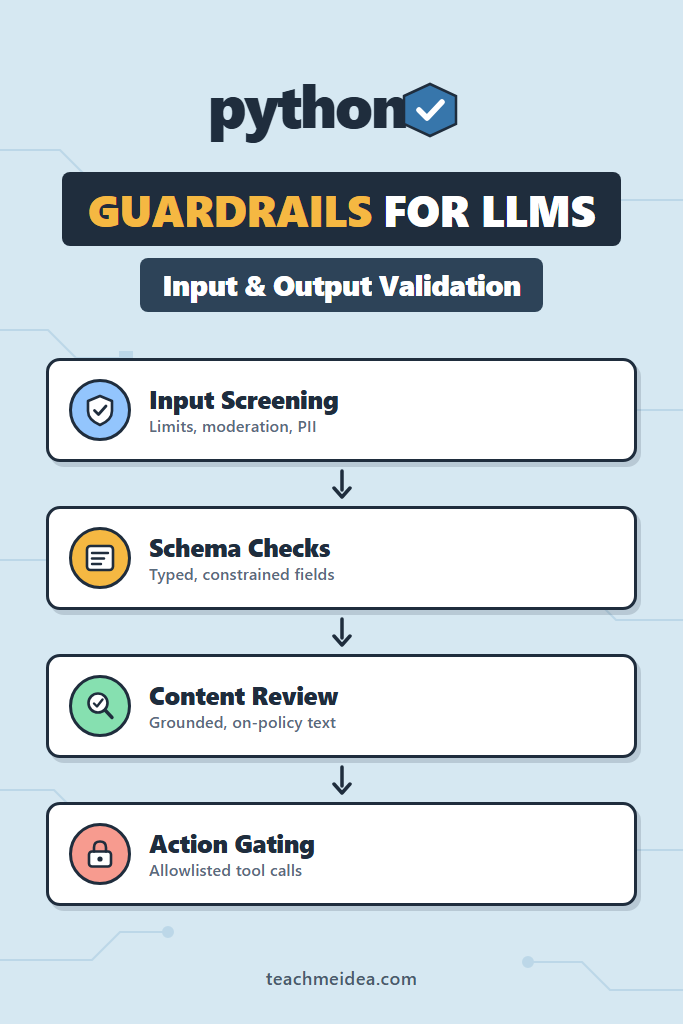
By the end, you will have a layered validation pipeline: structural checks on input, schema enforcement on output, semantic checks on content, and gating on any action the model tries to take. Every layer comes with Python you can adapt directly. Furthermore, you will know which layers are worth the latency and which ones quietly waste money.
What Are Guardrails for LLMs?
Guardrails for LLMs are deterministic validation layers that run before and after a model call to enforce rules the model itself cannot guarantee. Input guardrails screen prompts for length, policy violations, and injected instructions. Output guardrails verify structure, factual grounding, and safety before the response reaches a user or triggers an action.
The key word is deterministic. A system prompt that says “never reveal internal pricing” is a request. A regex that rejects any response containing an internal SKU pattern is a guarantee. Consequently, the most effective guardrail architectures push as much enforcement as possible out of the prompt and into ordinary code that you can unit test.
That distinction matters for a practical reason. Prompt-based rules degrade as conversations grow, as context fills up, and as users find phrasings your instructions never anticipated. Code does not degrade.
The Four Layers of Guardrails for LLMs
Most production systems converge on the same four layers. Each one catches a different failure class, and each one has a different cost profile.
| Layer | When it runs | What it catches | Typical added latency |
|---|---|---|---|
| Input validation | Before the model call | Oversized prompts, banned content, PII, injection attempts | 0–200 ms |
| Output schema validation | Immediately after generation | Malformed JSON, missing fields, wrong types | Under 5 ms |
| Output content validation | After schema passes | Hallucinations, ungrounded claims, leaked internals, unsafe text | 100 ms–2 s |
| Action gating | Before any tool or side effect runs | Destructive calls, out-of-scope tools, bad arguments | Under 5 ms |
Notice the asymmetry. Schema and action checks are nearly free because they are pure Python. Content checks are expensive because they usually require a second model call. Therefore, a sensible default is to run schema and action guardrails on every request, and reserve content guardrails for high-risk paths.
Layer 1: Validating Input Before It Reaches the Model
Input guardrails serve two goals at once. First, they protect the model from garbage that wastes tokens. Second, they protect you from users who are actively probing for weaknesses.
Start With Boring Structural Checks
Before anything clever, enforce the constraints you already know. Length caps, character sets, and token budgets catch a surprising share of real-world problems, and they cost nothing.
from pydantic import BaseModel, Field, field_validator
import tiktoken

# Shared encoder — instantiate once, not per request
ENCODER = tiktoken.get_encoding("o200k_base")
MAX_INPUT_TOKENS = 4000

class UserQuery(BaseModel):
    """Validated shape of anything a user sends to the model."""
    text: str = Field(min_length=1, max_length=20_000)
    conversation_id: str = Field(pattern=r"^[a-zA-Z0-9_-]{8,64}$")

    @field_validator("text")
    @classmethod
    def within_token_budget(cls, value: str) -> str:
        token_count = len(ENCODER.encode(value))
        if token_count > MAX_INPUT_TOKENS:
            raise ValueError(
                f"Query is {token_count} tokens; limit is {MAX_INPUT_TOKENS}"
            )
        return value

    @field_validator("text")
    @classmethod
    def strip_control_characters(cls, value: str) -> str:
        # Zero-width and control characters are a common obfuscation trick
        return "".join(ch for ch in value if ch.isprintable() or ch in "\n\t")
Why this works: character limits alone are not enough, because token count and character count diverge badly on code, emoji, and non-Latin scripts. Counting real tokens gives you a cost ceiling you can actually reason about. Meanwhile, stripping zero-width characters removes one of the cheapest ways to hide instructions inside otherwise innocent text. If Pydantic validators are new to you, the patterns in advanced Pydantic validation in FastAPI carry over directly.
Screen Content With a Moderation Endpoint
Both major providers expose a moderation classifier that costs nothing or close to it. Running it on user input is one of the highest-value guardrails available, particularly for consumer-facing products.
from openai import AsyncOpenAI

client = AsyncOpenAI()

BLOCKED_CATEGORIES = {"self_harm", "sexual/minors", "violence/graphic"}

async def passes_moderation(text: str) -> tuple[bool, list[str]]:
    """Return (allowed, triggered_categories) for a piece of user text."""
    response = await client.moderations.create(
        model="omni-moderation-latest",
        input=text,
    )
    result = response.results[0]

    triggered = [
        category
        for category, flagged in result.categories.model_dump().items()
        if flagged
    ]
    hard_blocks = [c for c in triggered if c in BLOCKED_CATEGORIES]
    return (len(hard_blocks) == 0, triggered)
Why this works: the function separates flagged from blocked. In practice you rarely want to reject everything the classifier flags, because the categories differ wildly in severity for your product. A legal research tool needs violence discussion; a children’s tutoring app does not. As a result, keeping the policy in a Python set rather than in the classifier lets product owners change it without touching model code. The OpenAI moderation documentation lists the full category taxonomy.
Redact PII Before It Leaves Your Network
If your users paste support tickets, resumes, or medical notes, some of that data should never reach a third-party API. Detection-and-redaction runs entirely on your infrastructure.
from presidio_analyzer import AnalyzerEngine
from presidio_anonymizer import AnonymizerEngine

analyzer = AnalyzerEngine()
anonymizer = AnonymizerEngine()

SENSITIVE_ENTITIES = ["EMAIL_ADDRESS", "PHONE_NUMBER", "CREDIT_CARD", "US_SSN"]

def redact_pii(text: str) -> tuple[str, int]:
    """Replace detected PII with typed placeholders. Returns (clean_text, count)."""
    findings = analyzer.analyze(
        text=text,
        entities=SENSITIVE_ENTITIES,
        language="en",
    )
    redacted = anonymizer.anonymize(text=text, analyzer_results=findings)
    return redacted.text, len(findings)
Why this works: placeholders such as <EMAIL_ADDRESS> preserve sentence structure, so the model still understands that a contact detail was present. Regex-only redaction tends to mangle text and confuse the model instead. However, be honest about the limits — Presidio is a recall-oriented detector, not a compliance guarantee. Treat it as defense in depth rather than as your only control.
Prompt injection deserves more than a paragraph, and dedicated classifiers now handle it better than handwritten rules. For that specific threat, the walkthrough on Lakera Guard for prompt injection detection covers the tooling in depth.
Layer 2: Forcing Output Into a Schema
Schema validation is the cheapest guardrail with the highest hit rate. Any time your application parses model output programmatically, an unvalidated json.loads() is a production incident waiting for a Tuesday.
from enum import Enum
from pydantic import BaseModel, Field
import instructor
from openai import OpenAI

class Sentiment(str, Enum):
    POSITIVE = "positive"
    NEUTRAL = "neutral"
    NEGATIVE = "negative"

class TicketTriage(BaseModel):
    """Structured triage decision for an inbound support ticket."""
    sentiment: Sentiment
    priority: int = Field(ge=1, le=5, description="1 = lowest, 5 = paging someone")
    category: str = Field(max_length=40)
    requires_human: bool
    reasoning: str = Field(min_length=20, max_length=600)

patched = instructor.from_openai(OpenAI())

def triage_ticket(ticket_body: str) -> TicketTriage:
    return patched.chat.completions.create(
        model="gpt-5",
        response_model=TicketTriage,
        max_retries=2,  # Validation errors are fed back to the model automatically
        messages=[
            {"role": "system", "content": "Triage the support ticket. Be conservative with priority 5."},
            {"role": "user", "content": ticket_body},
        ],
    )
Why this works: the constraints live in the type, not in the prompt. A priority of 7 is impossible, not discouraged. Additionally, max_retries=2 turns a validation failure into a self-correcting loop, because Instructor sends the Pydantic error message back to the model as a repair instruction. That pattern is covered end to end in the guide to structured LLM outputs with Instructor and Pydantic.
One caveat worth stating plainly: constrained decoding, such as OpenAI structured outputs, guarantees the shape but says nothing about the content. A perfectly valid TicketTriage can still contain a made-up category. Schema validation is layer two of four for exactly that reason.
Layer 3: Validating What the Output Actually Says
Content guardrails are where most teams stop too early. Nevertheless, this is the layer that catches the failures users actually complain about: confident answers with no basis in your data.
Check Groundedness for Retrieval-Backed Answers
For any RAG system, the single most valuable content check asks whether the answer is supported by the retrieved chunks.
from pydantic import BaseModel

class GroundednessVerdict(BaseModel):
    supported: bool
    unsupported_claims: list[str]

GROUNDEDNESS_PROMPT = """You are a strict fact-checker. Compare the ANSWER to the SOURCES.
List any claim in the ANSWER that is not directly supported by the SOURCES.
Do not use outside knowledge. If every claim is supported, return an empty list.

SOURCES:
{sources}

ANSWER:
{answer}"""

def check_groundedness(answer: str, sources: list[str]) -> GroundednessVerdict:
    return patched.chat.completions.create(
        model="gpt-5-mini",  # A cheaper model is sufficient for verification
        response_model=GroundednessVerdict,
        messages=[{
            "role": "user",
            "content": GROUNDEDNESS_PROMPT.format(
                sources="\n\n".join(f"[{i}] {s}" for i, s in enumerate(sources)),
                answer=answer,
            ),
        }],
    )
Why this works: verification is a strictly easier task than generation, so a smaller and cheaper model handles it well. Furthermore, forcing the checker to enumerate unsupported claims rather than emit a score gives you something actionable. You can strip the offending sentences, regenerate, or surface a “partially verified” badge in the UI.
Catch Silent Refusals and Empty Answers
Models sometimes return technically valid responses that are useless: hedged non-answers, apologies, or restated questions. These slip past schema validation every time.
import re

REFUSAL_MARKERS = re.compile(
    r"\b(i (cannot|can't|am unable to)|as an ai|i don't have access|"
    r"i'm not able to (help|assist))\b",
    re.IGNORECASE,
)

def is_useful_answer(answer: str, min_words: int = 15) -> bool:
    """Reject hedged non-answers before they reach the user."""
    if REFUSAL_MARKERS.search(answer):
        return False
    if len(answer.split()) < min_words:
        return False
    return True
Why this works: a refusal is not always wrong, but it should be a deliberate product decision rather than a silent fallback. When this check fires, route to a human handoff or a curated fallback message instead of showing the raw apology. In practice, teams find that a spike in this counter is an early warning that a retrieval index went stale.
Enforce Hard Output Rules With Plain Code
Some rules should never depend on a model at all. Internal identifiers, competitor names, unpublished pricing, and raw stack traces are all better handled with a deny-list.
FORBIDDEN_PATTERNS = [
    re.compile(r"\bINT-[A-Z]{2}-\d{6}\b"),        # Internal ticket IDs
    re.compile(r"\b(?:sk|pk)-[A-Za-z0-9]{20,}\b"), # Leaked API keys
    re.compile(r"Traceback \(most recent call last\)"),
]

def contains_forbidden_content(answer: str) -> str | None:
    for pattern in FORBIDDEN_PATTERNS:
        if pattern.search(answer):
            return pattern.pattern
    return None
Why this works: these checks run in microseconds and have a zero false-negative rate for the patterns they cover. Consequently, they belong on every response path, including streamed ones. For streaming, buffer output in small windows and scan each window before flushing to the client.
Layer 4: Gating Actions and Tool Calls
The moment your model can call functions, the blast radius changes. A hallucinated sentence is embarrassing; a hallucinated DELETE is an outage.
from typing import Any, Callable
from pydantic import BaseModel, ValidationError

class ToolPolicy(BaseModel):
    name: str
    handler: Callable[..., Any]
    args_model: type[BaseModel]
    requires_approval: bool = False

class ToolGate:
    """Allowlist plus argument validation for model-requested tool calls."""

    def __init__(self, policies: list[ToolPolicy]):
        self._policies = {p.name: p for p in policies}

    def execute(self, tool_name: str, raw_args: dict, user_approved: bool = False):
        policy = self._policies.get(tool_name)
        if policy is None:
            raise PermissionError(f"Tool '{tool_name}' is not in the allowlist")

        if policy.requires_approval and not user_approved:
            raise PermissionError(f"Tool '{tool_name}' needs explicit user approval")

        try:
            validated = policy.args_model(**raw_args)
        except ValidationError as exc:
            # Surface the error back to the model so it can correct the call
            raise ValueError(f"Invalid arguments for '{tool_name}': {exc}") from exc

        return policy.handler(**validated.model_dump())
Why this works: the allowlist is closed by default, so a model that invents a tool name gets a clean PermissionError rather than an attribute lookup on None. Moreover, separating requires_approval from execution means destructive operations pause for a human without duplicating handler logic. Agents that plan multi-step workflows need this discipline most, as the breakdown of AI agents with tools, planning, and execution explains.
What to Do When a Guardrail Fires
A guardrail that only knows how to say “no” makes the product worse. Each failure needs a response, and the right one depends on which layer tripped.
- Repair — for schema violations, feed the validation error back to the model and retry. Two attempts is the practical ceiling; beyond that, the model is usually stuck.
- Regenerate with constraints — for groundedness failures, retry with a stricter system prompt that names the specific unsupported claim.
- Degrade — for content violations, strip the offending portion and return the rest with a note, rather than discarding the whole answer.
- Refuse — for moderation and injection blocks, return a fixed message. Never echo the user’s input back in the error, since that creates a reflection vector.
- Escalate — for repeated failures on the same conversation, hand off to a human and flag the session.
class GuardrailError(Exception):
    def __init__(self, layer: str, detail: str, retryable: bool):
        self.layer = layer
        self.detail = detail
        self.retryable = retryable
        super().__init__(f"[{layer}] {detail}")

async def generate_with_guardrails(query: UserQuery, max_repairs: int = 2) -> str:
    allowed, categories = await passes_moderation(query.text)
    if not allowed:
        raise GuardrailError("input.moderation", ",".join(categories), retryable=False)

    clean_text, pii_count = redact_pii(query.text)

    for attempt in range(max_repairs + 1):
        answer = await call_model(clean_text)

        violation = contains_forbidden_content(answer)
        if violation:
            # Deny-list hits are not the model's fault to fix; log and fall back
            logger.warning("Forbidden pattern in output", extra={"pattern": violation})
            raise GuardrailError("output.denylist", violation, retryable=False)

        if is_useful_answer(answer):
            return answer

    raise GuardrailError("output.quality", "No useful answer after repairs", retryable=False)
Note the retry budget. Guardrail retries multiply your token spend and stack on top of provider-level backoff, so they need the same discipline as any other retry path. The trade-offs there are covered in LLM rate limiting and retry strategies.
Guardrails Libraries vs Rolling Your Own
Two open-source frameworks dominate this space, and both are reasonable choices. Still, neither one replaces the schema and action layers you should own directly.
| Approach | Best for | Main trade-off |
|---|---|---|
| Hand-rolled Pydantic + checks | Schema validation, action gating, deny-lists | You maintain the validator catalog yourself |
| Guardrails AI | Reusable validators, streaming validation, repair loops | Extra abstraction over a call you already control |
| NeMo Guardrails | Conversational flow control, dialogue rails | Colang DSL is a real learning curve |
| Hosted classifiers | Injection and toxicity detection at scale | Per-call cost plus an extra network hop |
The recommendation for most teams: own layers two and four in plain Python, because they are trivial to write and impossible to get wrong once tested. Then reach for a library at layers one and three, where the hard part is a maintained catalog of detectors rather than the plumbing.
A Realistic Failure: The Assistant That Answered Too Confidently
Consider a mid-sized B2B SaaS company that ships a documentation assistant over roughly 800 help-center articles. A small platform team builds it in a few sprints, and it works well in testing. After launch, support volume for one feature goes up rather than down.
The root cause turns out to be a gap between two systems. Product had deprecated a configuration option months earlier, but the old article stayed indexed. Retrieval kept surfacing it, and the model answered confidently every time, because nothing in the pipeline asked whether the retrieved source was still valid. Schema validation passed cleanly, since the output shape was never the problem.
The fix combines two guardrails rather than one. First, a metadata filter at retrieval time drops any chunk whose last_verified date is older than the current release cycle. Second, a groundedness check runs on answers about configuration topics, and unsupported claims trigger a “let me connect you with support” path. The trade-off is real: verification adds a second model call and noticeable latency to those answers. The team accepts it on that route specifically, and skips it on general navigation questions where a wrong answer costs almost nothing.
The general lesson generalizes well. Guardrails for LLMs are most valuable when scoped to the paths where being wrong is expensive, not applied uniformly across every request.
When to Use Guardrails for LLMs
- Model output feeds another system programmatically, such as a database write, an API call, or a UI component
- Users can supply arbitrary text, particularly if that text originates outside your organization
- Answers are grounded in retrieved documents and factual accuracy is the product
- The model can invoke tools with side effects, especially writes or external communication
- Your domain carries regulatory exposure around PII, medical content, or financial advice
- You need auditable evidence that a policy was enforced, not merely requested in a prompt
When NOT to Use Heavy Guardrails
- Internal prototypes where the only users are the engineers building the feature
- Low-stakes creative output such as brainstorming, where a strict validator mostly gets in the way
- Latency-critical paths under roughly 500 ms, where a verification model call breaks the interaction
- Cases where a simple deterministic rule already covers the risk, since an extra classifier adds cost without adding coverage
- Any layer you cannot afford to monitor, because an unmonitored guardrail silently drifts into either uselessness or over-blocking
Common Mistakes with LLM Guardrails
- Putting the policy in the prompt only. Instructions are advisory. If the rule matters, enforce it in code after generation.
- Blocking without a fallback. A rejected response with no alternative path is a worse experience than a mediocre answer. Always define what the user sees.
- Validating shape but not content. Valid JSON containing invented data passes every schema check you write. Groundedness needs its own layer.
- Skipping validation on streamed responses. Streaming makes checks harder, not optional. Buffer and scan in windows before flushing.
- Using an expensive model to verify an expensive model. Verification is easier than generation, so a smaller model usually suffices at a fraction of the cost.
- No metrics on guardrail firing rates. Without per-layer counters, you cannot tell whether a guardrail is protecting users or quietly blocking legitimate traffic.
- Treating redaction as compliance. Detectors have recall limits. Document them honestly rather than claiming coverage you cannot prove.
Putting Guardrails for LLMs Into Production
Guardrails for LLMs work best as layers, not as a single gate: cheap structural checks on the way in, schema enforcement on every parsed response, semantic verification on the paths where accuracy matters, and a closed allowlist around anything with side effects. Start with layer two and layer four today, since both are pure Python and take an afternoon to write. Then add input moderation, and only introduce groundedness checks where a wrong answer actually costs something.
A concrete first step: pick your riskiest model call, wrap its response in a Pydantic model with real field constraints, and add a counter for validation failures. That single metric will tell you more about your system’s reliability than any eval suite you run before launch. From there, the guide on structured LLM outputs with Instructor and Pydantic is the natural next read, and the OWASP Top 10 for LLM applications is worth keeping open while you decide which risks apply to your product.