Introduction
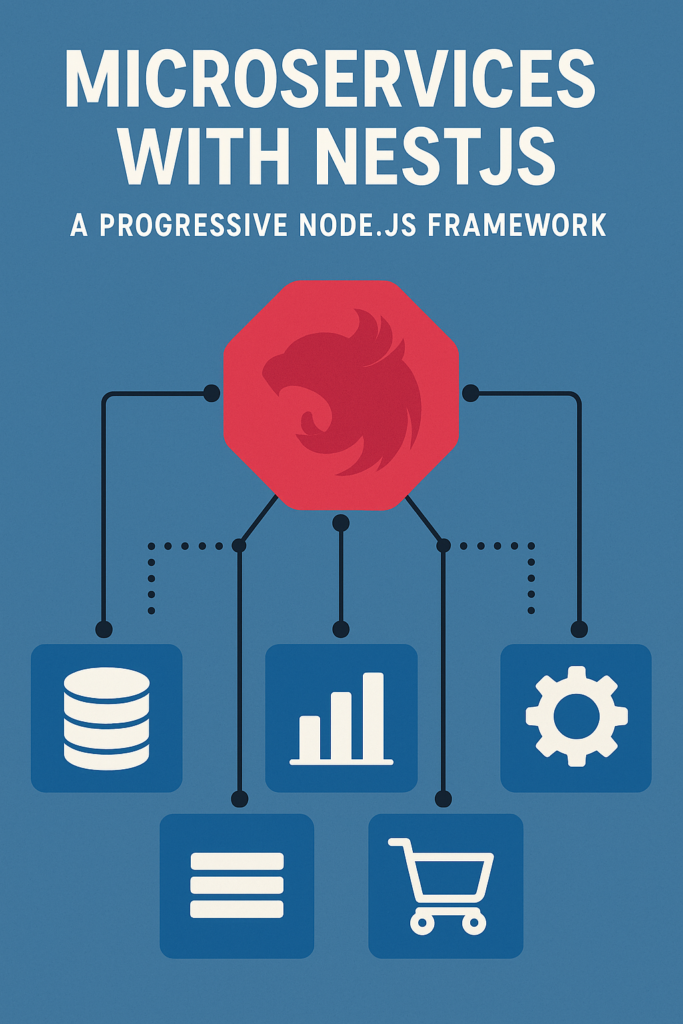
Microservice architecture has become the standard for applications that must grow quickly and serve large numbers of users. As systems expand, developers need frameworks that encourage structure, support asynchronous communication, and simplify integration across services. NestJS, a progressive Node.js framework built on TypeScript, offers exactly that. It provides a clear design, strong modularity, and multiple transport layers that make microservices easier to build and maintain. In this guide, you will learn how NestJS supports distributed development, how services exchange messages, and what best practices help you design scalable, resilient systems.
Why NestJS Works Well for Microservices
Choosing a framework for distributed applications is not simple, especially when teams need structure and flexibility at the same time. NestJS uses a modular layout that allows developers to break their systems into small, focused components. Its dependency injection system makes it easy to manage shared logic and swap implementations for testing.
The framework provides built-in support for message-driven systems through the @nestjs/microservices package. Flexible transport layer options let you choose between TCP, Redis, NATS, Kafka, gRPC, and more. Consistent architecture based on modules, providers, and controllers scales well from small projects to large enterprise systems. Native TypeScript support improves code quality and developer experience.
This combination makes NestJS a practical choice for large, distributed backends where team coordination and code consistency matter.
Transport Options in NestJS Microservices
Every distributed system has unique requirements for message delivery. NestJS offers several transport mechanisms that support different use cases.
TCP provides simple, lightweight communication suitable for internal service-to-service calls. Redis Pub/Sub enables quick message delivery with minimal setup. NATS offers high-speed distributed workflows with built-in clustering. MQTT works well for IoT devices and low-power networks. Kafka handles event-driven pipelines at scale with durability guarantees. gRPC provides strongly typed, high-performance RPC with Protocol Buffers.
Because these transports behave differently in terms of reliability, ordering, and throughput, teams should choose based on their specific requirements.
Message Patterns
NestJS supports two major patterns that appear in nearly all microservice systems.
Request/Response Pattern
A service sends a message and waits for a reply. This pattern works well for synchronous operations where the caller needs an immediate result.
import { Controller } from '@nestjs/common';
import { MessagePattern, Payload } from '@nestjs/microservices';
import { UserService } from './user.service';

@Controller()
export class UserController {
  constructor(private readonly userService: UserService) {}

  @MessagePattern({ cmd: 'get_user' })
  async getUser(@Payload() data: { userId: string }) {
    return this.userService.findById(data.userId);
  }

  @MessagePattern({ cmd: 'create_user' })
  async createUser(@Payload() data: CreateUserDto) {
    return this.userService.create(data);
  }
}
Event Pattern
A service broadcasts an event without expecting a response. This pattern enables loose coupling where multiple services can react to the same event independently.
import { Controller } from '@nestjs/common';
import { EventPattern, Payload } from '@nestjs/microservices';
import { AnalyticsService } from './analytics.service';

@Controller()
export class AnalyticsController {
  constructor(private readonly analyticsService: AnalyticsService) {}

  @EventPattern('user_created')
  async handleUserCreated(@Payload() data: UserCreatedEvent) {
    await this.analyticsService.trackUserSignup(data);
  }

  @EventPattern('order_completed')
  async handleOrderCompleted(@Payload() data: OrderCompletedEvent) {
    await this.analyticsService.trackPurchase(data);
  }
}
These patterns encourage loose coupling, which is essential for maintaining independent service lifecycles.
Creating a Microservice with NestJS
NestJS simplifies microservice creation through consistent patterns and CLI tooling.
Step 1: Create the Project
nest new user-service
cd user-service
npm install @nestjs/microservices
Step 2: Configure the Transport Layer
import { NestFactory } from '@nestjs/core';
import { Transport, MicroserviceOptions } from '@nestjs/microservices';
import { AppModule } from './app.module';

async function bootstrap() {
  const app = await NestFactory.createMicroservice(
    AppModule,
    {
      transport: Transport.REDIS,
      options: {
        host: process.env.REDIS_HOST || 'localhost',
        port: parseInt(process.env.REDIS_PORT || '6379'),
      },
    },
  );

  await app.listen();
  console.log('User microservice is listening');
}

bootstrap();
Step 3: Call from Another Service
import { Injectable, Inject } from '@nestjs/common';
import { ClientProxy } from '@nestjs/microservices';
import { firstValueFrom } from 'rxjs';

@Injectable()
export class OrderService {
  constructor(
    @Inject('USER_SERVICE') private readonly userClient: ClientProxy,
  ) {}

  async createOrder(userId: string, items: OrderItem[]) {
    // Fetch user from user-service
    const user = await firstValueFrom(
      this.userClient.send({ cmd: 'get_user' }, { userId }),
    );

    // Create order with user data
    const order = await this.orderRepository.create({
      userId: user.id,
      userEmail: user.email,
      items,
    });

    // Emit event for other services
    this.userClient.emit('order_created', {
      orderId: order.id,
      userId: user.id,
    });

    return order;
  }
}
Building Resilient Communication
Distributed systems must handle communication failures gracefully. Messages travel across networks where any delay or failure can break a workflow unless you design around it.
import { Injectable } from '@nestjs/common';
import { ClientProxy } from '@nestjs/microservices';
import { firstValueFrom, timeout, retry, catchError } from 'rxjs';

@Injectable()
export class ResilientClient {
  async sendWithRetry(client: ClientProxy, pattern: any, data: any): Promise {
    return firstValueFrom(
      client.send(pattern, data).pipe(
        timeout(5000), // 5 second timeout
        retry({
          count: 3,
          delay: (error, retryCount) => {
            // Exponential backoff: 1s, 2s, 4s
            const delay = Math.pow(2, retryCount - 1) * 1000;
            console.log(`Retry ${retryCount} after ${delay}ms`);
            return timer(delay);
          },
        }),
        catchError((error) => {
          console.error('All retries failed:', error);
          throw error;
        }),
      ),
    );
  }
}
Implement circuit breakers to protect overloaded services. Use dead-letter queues for failed messages that need manual investigation. These patterns significantly improve system reliability.
Real-World Production Scenario
Consider an e-commerce platform with separate services for users, products, orders, inventory, and notifications. The team uses NestJS with Redis as the transport layer for most inter-service communication and Kafka for event streaming to analytics.
When a customer places an order, the order service validates the request, reserves inventory through a synchronous call to the inventory service, creates the order record, and emits an order_created event. The notification service listens for this event and sends confirmation emails. The analytics service tracks the purchase for reporting.
This architecture allows each service to evolve independently. The inventory team can deploy updates without coordinating with the order team. If the notification service goes down, orders continue processing, and notifications queue up for later delivery.
Teams implementing this pattern commonly report faster deployment cycles since services can be updated independently. Debugging becomes more straightforward with proper distributed tracing through OpenTelemetry integration.
When to Use NestJS for Microservices
NestJS suits systems that need to scale across many teams or modules. Event-driven architectures benefit from NestJS’s built-in support for multiple message patterns. Real-time applications can leverage the same patterns used for internal communication. Enterprise systems with many domains map well to NestJS’s modular structure. Distributed processing pipelines work efficiently with Kafka or NATS transport layers.
When NOT to Use NestJS Microservices
Extremely small utilities or simple APIs may not need the full framework’s structure. If your system only has 2-3 services with straightforward HTTP communication, direct REST calls might be simpler. Teams unfamiliar with TypeScript or dependency injection face a learning curve before becoming productive.
Common Mistakes
Sharing databases between services creates tight coupling that defeats the purpose of microservices. Each service should own its data.
Using synchronous calls for everything creates cascading failures. Prefer events for operations that don’t need immediate responses.
Ignoring observability makes debugging distributed systems nearly impossible. Implement structured logging and distributed tracing from the start.
Not handling message failures leads to data loss. Always implement retry logic, timeouts, and dead-letter queues.
Conclusion
NestJS provides a clear and scalable way to build microservices in Node.js. Its modular design, rich transport options, and TypeScript foundation support the needs of modern distributed systems. Start with a simple two-service architecture to learn the patterns, then scale as your application grows.
If you want to explore related technologies, read “GraphQL Servers with Apollo & Express.” For backend framework comparisons, see “Framework Showdown: Flask vs FastAPI vs Django in 2025.” To learn more about official patterns, visit the NestJS microservices documentation. With strong messaging patterns and a clean structure, NestJS helps developers design reliable microservices that grow smoothly over time.