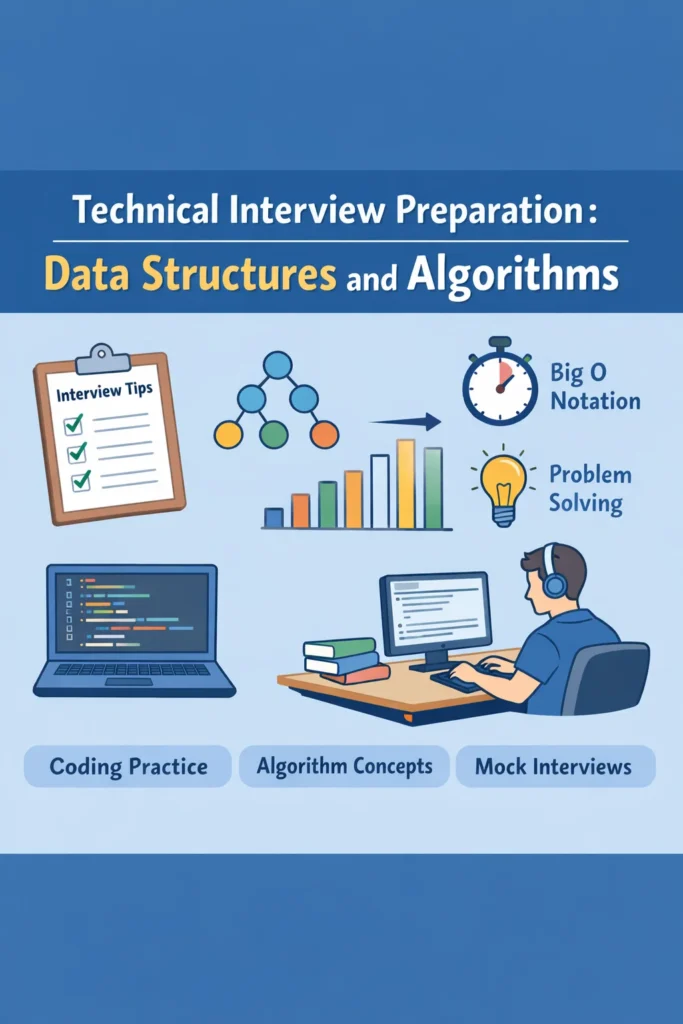
Technical interviews still rely heavily on data structures and algorithms. Even experienced engineers struggle when preparation feels random or unfocused. The problem usually is not intelligence—it is strategy.
In this guide, you will learn how to prepare for technical interviews by focusing on the right data structures, core algorithms, and problem-solving mindset that interviewers actually test.
Why Interviews Focus on Data Structures and Algorithms
Interviewers use data structures and algorithms to evaluate how you think under constraints. They look for:
- Logical reasoning
- Problem decomposition
- Trade-off awareness
- Code clarity
This approach helps companies assess long-term potential, not just framework knowledge. The same thinking skills appear in system design and backend work, as discussed in Understanding CAP Theorem and Practical Tradeoffs.
Core Data Structures You Must Know
You do not need to know everything. However, you must know the fundamentals deeply.
Arrays and Strings
Arrays and strings appear in almost every interview.
Focus on:
- Indexing and iteration
- Sliding window techniques
- Two-pointer patterns
- In-place modification
Many “hard” problems reduce to simple array logic once you spot the pattern.
Hash Maps and Sets
Hash-based structures test your ability to trade space for time.
You should understand:
- Average vs worst-case lookup
- Collision handling (conceptually)
- When hashing simplifies logic
Hash maps often turn nested loops into linear-time solutions.
Linked Lists
Linked lists test pointer manipulation and edge-case handling.
Prepare for:
- Reversal
- Cycle detection
- Merging lists
- Removing nodes
These problems reward careful thinking more than clever tricks.
Stacks and Queues
Stacks and queues appear frequently in parsing and traversal problems.
Common patterns include:
- Valid parentheses
- Monotonic stacks
- Breadth-first search
Understanding these patterns saves time during interviews.
Trees and Graphs
Trees and graphs test recursive thinking and traversal strategies.
You should be comfortable with:
- DFS and BFS
- Binary trees and BSTs
- Graph representation (adjacency list)
These problems connect directly to real systems like routing, permissions, and dependency graphs.
Essential Algorithms to Master
Knowing data structures is not enough. You must pair them with algorithms.
Sorting and Searching
You should know:
- How common sorts work conceptually
- Binary search and its variants
- When sorting simplifies a problem
Binary search often appears in non-obvious ways, especially in range-based questions.
Recursion and Backtracking
Recursion tests clarity of thought.
Prepare for:
- Base cases
- Tree recursion
- Backtracking templates
Clear structure matters more than raw speed here.
Dynamic Programming
Dynamic programming scares many candidates, but interviewers usually test basic patterns.
Focus on:
- Overlapping subproblems
- Memoization vs tabulation
- One-dimensional DP
Most DP problems follow a small set of templates.
Time and Space Complexity
Interviewers expect you to reason about complexity.
You should explain:
- Big-O time complexity
- Space usage
- Trade-offs between approaches
This skill ties closely to performance discussions found in PostgreSQL Performance Tuning: Indexes, EXPLAIN, and Query Optimization, where algorithmic thinking directly affects real systems.
How to Practice Effectively
Random practice wastes time. Structured practice builds confidence.
A good approach:
- Pick one topic per session
- Solve 2–3 problems deeply
- Review patterns, not just answers
Quality matters more than quantity.
Thinking Aloud During Interviews
Interviewers care about your reasoning process.
While solving:
- Restate the problem
- Clarify constraints
- Explain trade-offs
- Adjust based on feedback
Clear communication often matters as much as the final solution. These skills also improve collaboration, as highlighted in Code Review Best Practices: Giving and Receiving Feedback.
Common Interview Mistakes
Candidates often fail because they:
- Jump into coding too fast
- Ignore edge cases
- Freeze when stuck
- Stay silent
Slowing down and communicating clearly usually leads to better outcomes.
Whiteboard vs Real-World Code
Interview code does not need to be production-perfect. However, it should be:
- Correct
- Readable
- Reasonably efficient
Avoid over-engineering. Focus on clarity first, then optimize if needed.
How Much Preparation Is Enough
Preparation depends on experience and goals.
As a rule of thumb:
- Junior roles need broad exposure
- Mid-level roles need depth and patterns
- Senior roles need trade-off discussion
System design often follows algorithm rounds, which connects naturally to topics in Multi-Tenant SaaS App Design.
A Realistic Preparation Plan
A solid 6–8 week plan might include:
- Weeks 1–2: arrays, strings, hashing
- Weeks 3–4: trees, recursion, BFS/DFS
- Weeks 5–6: dynamic programming and graphs
- Weeks 7–8: mock interviews and review
Consistency matters more than intensity.
Conclusion
Technical interview preparation for data structures and algorithms is about pattern recognition, clear thinking, and communication. You do not need to memorize solutions—you need to understand why they work.
A practical next step is to choose one data structure today and solve two problems slowly and deliberately. That habit, repeated consistently, builds confidence far faster than cramming ever will.


3 Comments
Comments are closed.