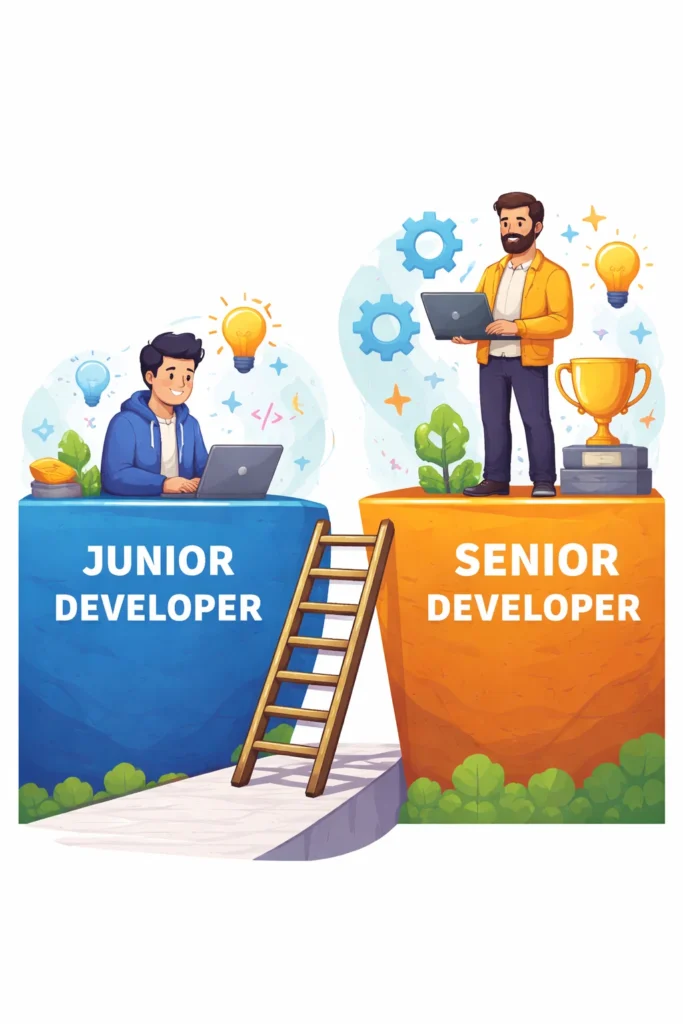
Moving from junior to senior developer is not about years of experience. It is about mindset, ownership, and impact. Many developers wait for a title change before behaving like seniors. However, growth usually happens in the opposite order.
In this guide, you will learn what actually separates junior and senior developers, how to close the gap intentionally, and which habits accelerate long-term growth.
What “Senior” Really Means
Senior does not simply mean “writes better code.”
Instead, senior developers:
- Think in systems, not just tasks
- Own problems end to end
- Anticipate risks before they appear
- Communicate clearly with both technical and non-technical stakeholders
Therefore, the shift from junior to senior is less about syntax and more about responsibility.
Deepen Technical Foundations
Strong fundamentals remain essential.
Senior developers:
- Understand data structures and complexity
- Write efficient queries
- Recognize performance trade-offs
- Choose appropriate architectures
If fundamentals feel weak, revisit core thinking skills like those discussed in Technical Interview Preparation: Data Structures and Algorithms. Senior engineers rarely struggle with basics.
Move from Tasks to Problems
Junior developers complete assigned tasks.
Senior developers ask:
- What problem are we solving?
- Is this the best approach?
- What edge cases exist?
This shift changes how you approach work. Instead of focusing on implementation only, you evaluate alternatives and long-term impact.
Think in Architecture, Not Just Features
As you grow, code organization matters more.
Senior developers:
- Define clear boundaries
- Reduce coupling
- Protect maintainability
- Prevent future technical debt
Understanding architectural trade-offs aligns closely with topics in Multi-Tenant SaaS App Design and broader system-level thinking.
Improve Communication Skills
Technical strength alone does not create seniority.
Senior developers:
- Write clear documentation
- Explain trade-offs simply
- Give structured feedback
- Align teams around decisions
Strong communication also improves code quality, as highlighted in Code Review Best Practices: Giving and Receiving Feedback.
If people understand your reasoning, they trust your decisions.
Take Ownership Proactively
Ownership clearly separates senior developers from junior ones.
In practice, it shows up through consistent behavior. Senior developers fix issues before anyone assigns them, improve code they did not originally write, and take responsibility when mistakes happen. They also make sure tasks reach full completion rather than stopping at partial fixes.
This proactive approach builds trust quickly within teams. Over time, that trust becomes one of the strongest indicators of senior-level maturity.
Mentor Without Being Asked
You do not need the “senior” title to mentor others.
Start by:
- Helping juniors debug
- Explaining architecture decisions
- Reviewing pull requests carefully
Teaching reinforces your own understanding and signals leadership.
Make Trade-Offs Explicit
Senior developers rarely aim for perfect code. Instead, they make trade-offs intentionally.
For example:
- Shipping faster vs long-term scalability
- Simplicity vs flexibility
- Performance vs readability
Understanding trade-offs becomes especially important in backend systems, as explored in Understanding CAP Theorem and Practical Tradeoffs.
Learn to Handle Ambiguity
Junior roles often come with clear instructions. Senior roles rarely do.
To grow:
- Clarify vague requirements
- Break large problems into smaller steps
- Identify missing information early
Comfort with ambiguity signals readiness for more responsibility.
Focus on Impact, Not Activity
Busy does not mean valuable.
Senior developers:
- Prioritize high-impact work
- Reduce unnecessary complexity
- Avoid overengineering
Instead of doing more tasks, they solve the right problems.
Improve Remote Leadership Skills
In remote environments, visibility depends on communication.
Senior developers working remotely:
- Share updates clearly
- Document decisions
- Keep teams aligned
These habits connect directly to practices discussed in Remote Work for Developers: Tools and Productivity Tips.
Stop Waiting for Permission
Many developers delay growth because they wait for promotion before acting like seniors.
Instead:
- Take initiative
- Propose improvements
- Lead small efforts
Titles often follow behavior, not the other way around.
Common Mistakes When Transitioning
Developers often struggle because they:
- Focus only on technical skills
- Avoid difficult conversations
- Resist feedback
- Try to control everything
Balance technical depth with collaboration and humility.
A Practical Growth Plan
If you want to move from junior to senior within 1–2 years, consider this approach:
- Quarter 1: Strengthen fundamentals and system understanding
- Quarter 2: Lead small features end to end
- Quarter 3: Mentor one teammate consistently
- Quarter 4: Propose and implement architectural improvements
Structured growth creates visible progress.
Senior Is a Mindset
Seniority reflects consistent behavior over time. It comes from reliability, clarity, and long-term thinking.
If you want to accelerate your transition, focus on:
- Ownership
- Communication
- Architectural awareness
- Decision-making under uncertainty
Conclusion
Transitioning from junior to senior developer is not about memorizing more syntax. It is about expanding your scope of responsibility and impact. When you think beyond tasks and act with ownership, growth becomes visible.
A practical next step is to identify one area where you can take more ownership this week. Small shifts in responsibility compound quickly—and that is how seniority begins.


1 Comment