This post is for Flutter developers and tech leads who are picking a state library and keep seeing one argument repeated: “Riverpod has the most downloads, so it is the standard.” Flutter state management 2026 roundups lean on pub.dev numbers, and nobody checks them against what real apps ship. So this post does both. First, it reads the 30-day download counts for every major state package on one day. Then it counts which of those packages 100 active open source Flutter apps actually import, file by file. As a result, you will see where the two rankings agree, where they split sharply, and why a download count tells you less than it seems. By the end, you can defend a library choice with numbers instead of a popularity chart.
The numbers in this post came from this environment:
Measured 2026-11-16
Windows 11 Pro 25H2 (build 26200), AMD Ryzen 5 8600G (6C/12T), 16 GB RAM
Dart 3.9.0, Git 2.48.1 (Git for Windows, Git Bash)
pub.dev API read 2026-11-16 09:46 UTC
GitHub search API read 2026-11-16, every repo read at its default-branch HEAD that day
These are counts, not timings, so the machine does not change them and there is no run-to-run spread to report. Therefore, each source was read once. However, the counts move every day: downloads roll over a 30-day window, and repos keep committing. So treat every table here as a dated snapshot, and expect a different answer if you run it in six months.
Flutter State Management 2026: Downloads vs Real Usage
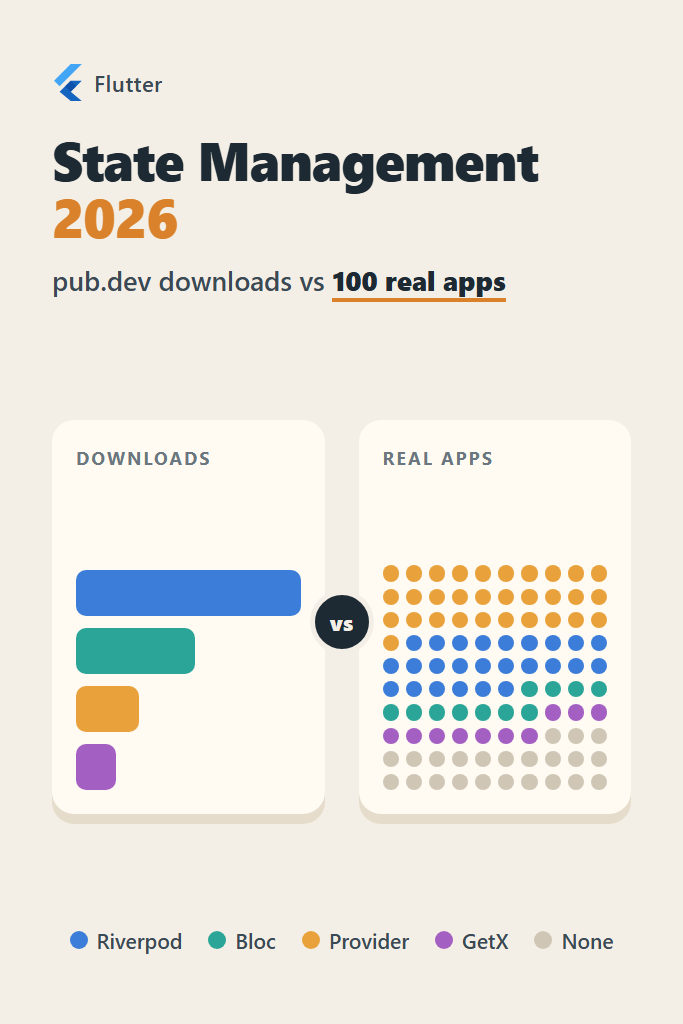
On 2026-11-16, flutter_riverpod had 3.6 times provider’s monthly downloads and 49.1% of all downloads across the seven Flutter-facing state packages. In the 100 most-starred active open source Flutter apps, however, Provider was the main state library in 31 apps and Riverpod in 25. In short, downloads and real usage rank the leaders in a different order.
| Library | Package read | pub.dev downloads, 30 days | Share of downloads | Main library in the 100 apps |
|---|---|---|---|---|
| Riverpod | flutter_riverpod | 4,406,581 | 49.1% | 25 |
| Bloc | flutter_bloc | 2,343,911 | 26.1% | 11 |
| Provider | provider | 1,219,440 | 13.6% | 31 |
| GetX | get | 799,516 | 8.9% | 10 |
| MobX | flutter_mobx | 115,211 | 1.3% | 0 |
| Redux | flutter_redux | 51,987 | 0.6% | 0 |
| Signals | signals_flutter | 36,623 | 0.4% | 0 |
| No library | none | n/a | n/a | 23 |
Note that the download share uses the package a Flutter app depends on directly, so flutter_riverpod rather than riverpod. Similarly, “main library” means the family imported by the most Dart files in that app. Both definitions are explained below, with the commands behind them.
What pub.dev Download Counts Actually Measure
A pub.dev download is one fetch of a package archive from the pub.dev server. In other words, it is not one user and not one app. pub.dev’s own scoring help page is direct about this: “The download count is not a direct measure of how many users a package has.” Two mechanisms push the number away from real usage, and they push in opposite directions.
First, caching pulls the count down. The pub client keeps archives in a shared PUB_CACHE, so “a particular package version will only be downloaded once per user on a particular developer machine.” For example, a developer with ten projects on Provider counts once. Second, CI pulls the count up. The same page notes that counts “can also be highly affected if the package is used by CI systems running tests, since these systems typically don’t retain the PUB_CACHE between test runs.” In other words, a team with a busy pipeline downloads its whole dependency tree on every run.
There is a third effect too. In particular, the page adds that a package’s number “can be high if the package is used as a dependency by other popular packages.” That matters here, because the state packages depend on each other.
The Raw pub.dev Numbers
Each package’s score endpoint returns downloadCount30Days, likeCount and grantedPoints, and the package endpoint returns the latest version and its dependencies. This loop saved both for 23 packages:
mkdir -p pub
for p in flutter_riverpod riverpod hooks_riverpod flutter_bloc bloc hydrated_bloc \
         provider get mobx flutter_mobx redux flutter_redux async_redux fish_redux \
         signals signals_flutter stacked states_rebuilder flutter_solidart solidart \
         watch_it get_it flutter_hooks; do
  curl -s "https://pub.dev/api/packages/$p/score" -o "pub/$p.score.json"
  curl -s "https://pub.dev/api/packages/$p" -o "pub/$p.json"
done
After that, a short Dart script printed one row per package: name, 30-day downloads, likes, pub points, latest version, its publish date, and its direct dependencies. This is the raw output:
## pub.dev
async_redux	13061	158	150	29.2.3	2026-10-11	async_redux_core,fast_immutable_collections,weak_map,connectivity_plus,collection,logging,path,file,path_provider,meta,flutter
bloc	2492291	3224	160	9.2.1	2026-05-12	meta
fish_redux	1618	66	40	0.3.8	2023-12-08	flutter
flutter_bloc	2343911	8091	160	9.1.1	2025-05-02	bloc,flutter,provider
flutter_hooks	371246	2431	160	0.21.4	2026-11-06	flutter
flutter_mobx	115211	719	160	2.4.0	2026-09-11	flutter,mobx,provider
flutter_redux	51987	573	160	0.10.0	2022-05-14	redux,flutter
flutter_riverpod	4406581	2920	140	3.5.0	2026-11-06	collection,flutter,flutter_test,material_ui,meta,riverpod,state_notifier
flutter_solidart	6329	82	160	2.7.4	2026-05-21	collection,flutter,meta,solidart
get	799516	15605	140	4.7.3	2025-11-24	flutter,web
get_it	2556179	4732	160	9.3.0	2026-09-19	async,collection,meta
hooks_riverpod	700587	932	150	3.5.0	2026-11-06	collection,flutter,flutter_hooks,flutter_riverpod,flutter_test,material_ui,riverpod,state_notifier
hydrated_bloc	248306	974	160	11.0.0	2026-03-22	bloc,hive_ce,meta,synchronized
mobx	127128	1333	160	2.7.0	2026-09-11	meta,collection
provider	1219440	11012	150	6.1.5+1	2025-08-19	collection,flutter,nested
redux	76953	417	135	5.0.0	2021-02-23
riverpod	4535309	4044	160	3.5.0	2026-11-06	async,clock,collection,listen,meta,stack_trace,state_notifier,test_api,uuid
signals	26042	715	160	7.1.0	2026-05-29	flutter,signals_core,signals_flutter,signals_hooks
signals_flutter	36623	93	150	7.1.0	2026-05-29	flutter,signals_core
solidart	6191	80	150	2.8.6	2026-05-21	alien_signals,collection,meta
stacked	69624	1487	120	3.5.0	2025-08-19	flutter,get_it,meta,provider,collection,stacked_shared,universal_io,path,web
states_rebuilder	17212	409	150	6.4.0	2024-02-20	flutter,flutter_localizations,collection,meta,navigation_builder
watch_it	14193	213	160	2.5.0	2026-09-19	get_it,listen_it,flutter
Three Oddities in Those Numbers
To begin with, the dependency column explains part of the ranking. For example, riverpod (4,535,309) sits above flutter_riverpod (4,406,581) because every Flutter install of Riverpod also fetches the pure Dart core. Likewise, bloc (2,492,291) sits above flutter_bloc (2,343,911). That is why the comparison table reads the Flutter-facing package, not the core.
The second oddity, however, is harder to explain. flutter_bloc 9.1.1, flutter_mobx and stacked all list provider as a direct dependency, so every fresh flutter_bloc resolve also needs provider. Even so, provider shows 1,219,440 downloads against flutter_bloc’s 2,343,911. If downloads were a simple count of resolves, provider could never trail a package that depends on it. pub.dev does not document why it does, so the honest reading is that the counts are an indicator, as the help page says, and not a census.
Finally, release timing differs widely. Riverpod 3.5.0 shipped on 2026-11-06, ten days before the read, while provider’s latest release is from 2025-08-19. Because a new version is a new archive, every cache has to fetch it once. Admittedly, this post did not measure how much of Riverpod’s lead comes from its release pace. However, it is one more reason the download ranking and the usage ranking can drift apart.
How the 100 Flutter Apps Were Chosen
Download counts are only half of the flutter state management 2026 picture, so the other half needs a sample of real apps. The corpus comes from GitHub’s flutter-app topic, sorted by stars. Since the search API returns at most 1,000 results, ten pages of 100 cover the whole ranked list. Unauthenticated calls are rate-limited, but ten calls fit inside the limit.
for p in 1 2 3 4 5 6 7 8 9 10; do
  curl -s -H "Accept: application/vnd.github+json" \
    "https://api.github.com/search/repositories?q=topic:flutter-app&sort=stars&order=desc&per_page=100&page=$p" \
    -o "search_$p.json"
done
From those 1,000 repos, the filters ran in this order:
- First, drop forks and archived repos: 963 left.
- Next, keep repos pushed in the 12 months before 2026-11-16, plus the top 250 by stars for the historical comparison: 377 scanned.
- Then keep repos holding a Flutter app, meaning a
pubspec.yamlwithflutteras an SDK dependency and alib/main*.dartentry point beside it: 348. - After that, drop example collections with more than three apps in one repo: 341.
- Also keep only repos whose default-branch HEAD commit is dated 2025-11-16 or later: 177 active apps.
- Finally, take the 100 most-starred of those.
Step 5 is stricter than step 2 on purpose. Because GitHub’s pushed_at changes when any branch receives a push, 11 app repos had recent pushes but an older default branch. As a result, the final 100 range from 22,867 stars down to 27, with a median of 129.5. Together they hold 17,971 Dart files outside test and example folders.
Cloning 377 Repos Without Downloading Their Assets
Full clones of 377 Flutter apps would pull gigabytes of images, fonts and native code. Instead, a blobless shallow clone fetches only the commit and its file tree. Then a sparse checkout downloads only the files you ask for, so this script fetches nothing but Dart sources:
#!/usr/bin/env bash
# Count the Dart files in one GitHub repo that import each state management family.
# Usage: ./count_imports.sh owner/repo
set -euo pipefail

repo="$1"
dir="repos/${repo//\//__}"

# Blobless shallow clone: commits and trees only, file contents fetched on demand.
if [ ! -d "$dir" ]; then
  git clone --quiet --depth 1 --filter=blob:none --no-checkout \
    "https://github.com/$repo.git" "$dir"
fi
# Download only Dart sources, never images, fonts or native code.
git -C "$dir" sparse-checkout set --no-cone '*.dart'
git -C "$dir" checkout --quiet HEAD

count() {
  # Files outside example/ and test/ folders, generated code skipped.
  find "$dir" -name '*.dart' ! -name '*.g.dart' ! -name '*.freezed.dart' \
    -not -path "$dir/.*" -not -path '*/example/*' -not -path '*/examples/*' \
    -not -path '*/test/*' -not -path '*/integration_test/*' -print0 \
    | xargs -0 grep -lE "package:($1)/" 2>/dev/null | wc -l || true
}

printf '%s\t%s %s\t%s %s\t%s %s\t%s %s\n' "$repo" \
  riverpod "$(count 'riverpod|flutter_riverpod|hooks_riverpod')" \
  bloc "$(count 'bloc|flutter_bloc|hydrated_bloc|replay_bloc')" \
  provider "$(count 'provider')" \
  getx "$(count 'get')"
Notably, the trailing slash in package:get/ matters. Without it, the GetX pattern would also match package:get_it/, which is a service locator and not a state library. Similarly, skipping .g.dart and .freezed.dart keeps code generation from inflating Riverpod and Bloc counts. The --filter=blob:none and sparse checkout flags are documented in Git’s partial clone and sparse-checkout references.
In practice, the full survey ran the same logic from a Dart script with six parallel workers, covering seven families. On four spot-checked repos, the bash script above reproduced the Dart script’s counts exactly:
CarGuo/gsy_github_app_flutter	riverpod 17	bloc 0	provider 6	getx 0
openfoodfacts/smooth-app	riverpod 0	bloc 0	provider 204	getx 0
Livinglist/Hacki	riverpod 0	bloc 85	provider 0	getx 0
anandnet/Harmony-Music	riverpod 0	bloc 0	provider 0	getx 82
Why Imports Beat pubspec Lines
A pubspec.yaml line says a package was added at some point. An import, by contrast, says the code uses it today. In fact, the two disagree more often than you might expect: in the 100 apps, four declared a state package that no Dart file imported. Specifically, two declared Provider, one GetX and one Signals. Counting imports also shows how deep a library goes, which a dependency list cannot.
What 100 Active Flutter Apps Actually Import
This is the raw output for the 100 apps. Here, “repos importing” counts apps with at least one importing file. Meanwhile, “primary in” counts apps where that family has the most importing files. Finally, “files importing” sums the importing files across all 100 apps.
## Active top 100 (n=100)
family	repos importing	primary in	files importing
Riverpod	27	25	1425
Bloc	13	11	564
Provider	33	31	937
GetX	11	10	461
MobX	1	0	6
Redux	1	0	16
Signals	1	0	2
none	23	23	-
repos importing more than one family	8
Provider Is Still the Most Common Main Library
Overall, Provider was the primary library in 31 of the 100 apps, ahead of Riverpod at 25. Among the 77 apps that use any library, that is 40.3% for Provider against 32.5% for Riverpod, the reverse of their download shares. Furthermore, the Provider apps are not only abandoned code. After all, every app in this set had a commit in the last 12 months, and the Provider group includes large, active projects such as Open Food Facts’ smooth-app, with 204 importing files.
Mixing, however, is rare. Only 8 of the 100 apps import more than one family. Of those, Provider appears next to Riverpod in three, next to Bloc in two and next to MobX in one. In some of them, though, Provider plays a supporting role. In pluto it hands MobX stores down the widget tree, and in moodiary its only use comes through a third-party asset picker’s API.
Riverpod Leads in Files, Not in Repos
Riverpod has fewer apps than Provider but more importing files: 1,425 against 937. As a result, that works out to about 53 importing files per Riverpod app, compared with 28 for Provider, 43 for Bloc and 42 for GetX. In practice, Riverpod apps route more of their code through the library, which fits its role as both state container and dependency injection.
The version constraints show the Riverpod apps are current, too. For example, of the 39 active apps that pin flutter_riverpod, 28 are on 3.x, 10 on 2.x and one on 1.x. Code generation is also common: 16 declare riverpod_annotation, 12 of them on 4.x. If you are weighing that generator, the costs are measured in the case against Riverpod as a default.
23 Apps Use No State Library at All
Almost a quarter of the apps import none of the seven families. However, that does not mean they have no state management. To check, this loop counts files using Flutter’s built-in tools in each of them:
# none.txt: the 23 repos that import no state library, one owner/repo per line
while read -r repo; do
  d="repos/${repo//\//__}"
  cn=$(grep -rlE --include='*.dart' 'extends ChangeNotifier|with ChangeNotifier' "$d" | wc -l)
  vn=$(grep -rlE --include='*.dart' 'ValueNotifier<|ValueListenableBuilder' "$d" | wc -l)
  ss=$(grep -rlF --include='*.dart' 'setState(' "$d" | wc -l)
  printf '%s\tCN=%s\tVN=%s\tsetState=%s\n' "$repo" "$cn" "$vn" "$ss"
done < none.txt
mitesh77/Best-Flutter-UI-Templates	CN=0	VN=0	setState=15
gokadzev/Musify	CN=2	VN=27	setState=20
mrrfv/open-android-backup	CN=0	VN=0	setState=3
Kyosee/VeneraX	CN=25	VN=7	setState=133
BoltzmannEntropy/MimikaStudio	CN=0	VN=0	setState=18
nfcim/nfsee	CN=0	VN=0	setState=6
Purehi/wetube_flutter	CN=0	VN=2	setState=26
LumiDesk/verifin	CN=14	VN=21	setState=90
JideGuru/animation_playground	CN=0	VN=0	setState=14
wisamidris77/flux	CN=0	VN=1	setState=16
omegaui/cliptopia	CN=0	VN=0	setState=52
hey24sheep/azure-flutter-tasks	CN=0	VN=0	setState=1
IstiN/flutter_agent_harness	CN=43	VN=16	setState=92
WheretoSleepinNJU/NJU-Class-Shedule-Flutter	CN=0	VN=5	setState=25
0-manbir/minimalauncher	CN=0	VN=0	setState=7
Jamalianpour/open-dev	CN=0	VN=5	setState=30
huffSamuel/upnp_explorer	CN=0	VN=0	setState=6
DMouayad/my_quran	CN=2	VN=3	setState=9
mikufoxxx/WordFlow	CN=0	VN=0	setState=13
Jean28518/invoice-creator-german	CN=0	VN=1	setState=4
imtusharrai/foodordering_flutterapp	CN=1	VN=0	setState=2
chathushkaimasara/My-Workouts	CN=1	VN=2	setState=7
santhoshraje/i-attendance	CN=0	VN=0	setState=2
Twelve of the 23 use ChangeNotifier or ValueNotifier, which is the pattern Flutter’s architecture recommendations describe. In contrast, the other eleven get by on setState alone. Notably, some of them are not small: VeneraX and flutter_agent_harness each run dozens of notifier files with no package at all. For the limits of that approach, the site’s setState vs Provider comparison covers where that approach stops scaling.
Apps That Went Quiet Tell a Different Story
In addition, the scan covered 164 app repos whose last commit predates 2025-11-16. This view counts declared dependencies rather than imports, so its numbers are not directly comparable with the table above. Still, the shift between the two groups is large:
## All active (n=177)
Provider	60
Riverpod	43
Bloc	23
GetX	17
...
none of these	45

## Last commit before 2025-11-16 (n=164)
Provider	43
GetX	26
Bloc	23
Riverpod	11
...
none of these	70
Specifically, Riverpod is declared in 24.3% of active apps but only 6.7% of quiet ones. GetX, on the other hand, moves the other way, from 15.9% of quiet apps down to 9.6% of active ones. Its strongest year was apps last touched in 2023, where it led every other library with 12 of 44. Meanwhile, Provider stays near a quarter to a third in both groups.
There are two readings here, and yet the data cannot separate them. Either new apps choose Riverpod more often, or the projects that picked Riverpod are the ones still being maintained. Either way, the gap is real. It suggests that Riverpod’s download lead in flutter state management 2026 partly reflects where new work happens.
Does App Size Predict the State Library?
Somewhat, as it turns out. Taking the median count of Dart files per app, grouped by main library, gives a clear order:
| Main library | Apps | Median Dart files | Largest app |
|---|---|---|---|
| No library | 23 | 43 | 1,534 |
| GetX | 10 | 73 | 135 |
| Provider | 31 | 137 | 948 |
| Riverpod | 25 | 153 | 664 |
| Bloc | 11 | 181 | 518 |
Bloc apps are the largest by median, which matches its reputation for structure that pays off as the codebase grows. By contrast, GetX apps are the smallest library users, and no GetX app in the set passed 135 files. However, the groups are small, so treat this as a direction rather than a rule. For how Riverpod and Bloc compare on rebuild behaviour in one screen, see the Riverpod vs Bloc rebuild counts, which found they tie when written the same way.
Is Riverpod Better Than Provider in 2026?
Not by this data, and not by downloads either. After all, the numbers show what developers pick, not what works better. On one side, Riverpod gives you compile-time safety, caching and async primitives that Provider lacks, and its apps lean on it heavily. Provider, by contrast, is simpler and still runs more of the active apps sampled here. The site’s Provider vs Riverpod vs Bloc comparison covers the feature trade-offs. Beyond that, this post adds the evidence that neither one is a fringe choice.
A Real Scenario: Picking a Library for a Team App
Consider a small team of three or four Flutter developers starting a mid-sized business app, roughly 30 to 50 screens with offline caching. At first, the tech lead’s proposal says “Riverpod, because it has twice the downloads of anything else.” Then a reviewer pushes back, and the lead needs a better argument within the week.
As it stands, the download claim does not hold up. As shown above, pub.dev’s own help page warns against reading downloads as users, and in 100 active apps Provider leads on adoption. Instead, a stronger case would use the facts that actually distinguish the libraries. For one, the app has many async sources with caching, which is Riverpod’s strength, and Riverpod apps here route about 53 files each through the library, so the team should expect the same depth. On the other hand, the cost is a dependency that moves fast: Riverpod 3.5.0 shipped ten days before this read, and ten of the active Riverpod apps still sit on 2.x.
Framed that way, the decision becomes concrete: Riverpod for its async model, with a plan for keeping up with releases. If the app had turned out simple, the same data would support Provider or plain ChangeNotifier without apology.
When to Use Each Flutter State Management Library in 2026
Choose Provider When
- The app is small to mid-sized, so most state stays local to a feature
- The team wants the smallest API surface and, as a result, the fewest moving parts
- You maintain an existing Provider app; in fact, 31 of 100 active apps still run on it, so it is not legacy
Reach for Riverpod When
- The app has many async data sources that also need caching, invalidation and derived state
- You want dependency injection and state in one tool, especially if it will reach most of the codebase
- The team can absorb frequent releases and, in addition, an optional code generator
Pick Bloc When
- The codebase is large or expected to grow, since Bloc apps here had the highest median size
- You want explicit events and states that reviewers can trace, particularly in a large team
Stay on Built-In Notifiers When
ChangeNotifierandValueNotifieralready cover the state you have; for example, 12 of the 23 no-library apps do exactly that- You would rather add a package once a concrete need appears than up front
When NOT to Use Download Counts to Choose
- When packages have different release cadences, because every cache fetches each new version again
- When one package depends on another, as
flutter_blocdoes onprovider, since that muddies both numbers - When your team’s CI setup differs from the average, because CI runs without a cache inflate counts
- When the real question is “what do apps like mine use”, which, in the end, only a usage survey answers
Common Mistakes When Reading Popularity Data
- Comparing
riverpodwithproviderinstead offlutter_riverpod, because the core package adds transitive downloads to Riverpod’s side - Treating likes as usage; for instance,
gethas 15,605 likes, the most of any package here, yet leads in neither downloads nor active apps - Counting
pubspec.yamllines instead of imports, which as a result keeps 4 dead dependencies in the tally - Matching
package:getwithout the slash, so that everyget_itimport also gets counted - Reading an old “top packages” list as current; in fact, the 2025 roundup of top state packages and this snapshot already differ
What This Measurement Does Not Cover
A survey with unstated limits is a trap, so here are the limits. First, open source apps are not the whole flutter state management 2026 market. Commercial apps live in private repos, and agencies or enterprises may favour Bloc or Riverpod more than hobby projects do. The corpus also depends on authors tagging their repos flutter-app, which is a self-selected group. Furthermore, sorting by stars favours older, well-known projects.
Second, “main library” is a heuristic. It picks the family with the most importing files, so an app that uses Provider in many widgets for theming and Riverpod in fewer files for every feature would count as Provider. Only 8 apps mixed families, though, so this edge case affects few rows. Finally, the scan covers seven families. Packages like get_it (12 of the 100 apps) and flutter_hooks (6) were counted as dependencies but not treated as state libraries, and stacked, states_rebuilder and solidart barely appear.
Conclusion
Flutter state management 2026 looks different depending on what you count. On one hand, pub.dev downloads put Riverpod far ahead, with 49.1% of Flutter-facing state package downloads. On the other hand, real usage in 100 active open source apps puts Provider first as the main library, with Riverpod close behind and used more deeply. Meanwhile, Bloc tends to run the biggest apps, and almost a quarter of apps use no package at all.
So the next time a proposal cites download counts, ask for the use case instead. Then pick the library whose strengths match your app’s state, and treat popularity as a tiebreaker at most. If Riverpod is the candidate, read the 2025 case for Riverpod and the 2026 case against it side by side before you commit.
The 100 Apps Behind These Numbers
Each app below was read at its default-branch HEAD on 2026-11-16, so you can check any row with git log --before=2026-11-17 -1 on its repo. Likewise, star counts are from the same day, and the apps are grouped by main library, in descending order of stars.
Apps Where Provider Is the Main Library (31)
Provider leads this sample, so it also has the longest list. In order: simplezhli/flutter_deer (8628 stars), openfoodfacts/smooth-app (1455 stars), mhmzdev/the-holy-quran-app (893 stars), AmosHuKe/Mood-Example (651 stars), amugofjava/anytime_podcast_player (627 stars), xiaobaimc/myune_music (502 stars), DanXi-Dev/DanXi (438 stars), Robert-Stackflow/CloudOTP (275 stars), enrique-lozano/Monekin (271 stars), QuantumPhysique/trale (253 stars), Scriptbash/Wispar (226 stars), 93Pd9s8Jt/atba (186 stars), shabake/GHMall (172 stars), dz0ny/meshcore-sar (170 stars), DargonLee/easy_pasta (165 stars), lyskouski/app-finance (143 stars), imshibaji/flutter_clean_architecture (134 stars), sunyongsheng/Allpass (122 stars), J-shw/Menstrudel (116 stars), Robert-Stackflow/Loftify (114 stars), rsoft-in/scrawler (89 stars), sagarchaulagai/aradia (85 stars), padvincenzo/silence-speedup (65 stars), alphaolomi/food-app (52 stars), maxim-saplin/dikt (48 stars), HarmanPreet-Singh-XYT/Scolect-ScreenTimeApp (42 stars), BirjuVachhani/pluto (41 stars), IsKenKenYa/1Panel-Client (40 stars), nikhileshmeher0204/ScanMyFood (39 stars), peercoin/peercoin_flutter (32 stars), BrisaAnahiEscobar/mailflow (31 stars).
Apps Where Riverpod Is the Main Library (25)
Next come the Riverpod apps, which import it in more files per app than any other group. In order: CarGuo/gsy_github_app_flutter (15515 stars), ZhuJHua/moodiary (2077 stars), iota9star/mikan_flutter (1387 stars), darkmoonight/Rain (1095 stars), simonbengtsson/airdash (670 stars), ferraridamiano/ConverterNOW (632 stars), freeCodeCamp/mobile (587 stars), rignaneseleo/SlimSocial-for-Facebook (571 stars), adeeteya/Classipod (372 stars), roshancodespace/ShonenX (359 stars), abduznik/Freegosy (299 stars), elrizwiraswara/flutter_pos (222 stars), shiosyakeyakini-info/miria (216 stars), axel10/vynody (177 stars), vbalagovic/flutter-presetup (132 stars), Udhay-Adithya/vitap_student_app (127 stars), polilluminato/wassword-flutter (97 stars), jangviktor-web/finance_chart (50 stars), Neiroha/Neiroha (48 stars), JUANIMAN/PerfMTK-Manager (39 stars), Lasslos/EigenPlan (35 stars), vincenzo-afk/GHOSTHUB (33 stars), Swappppy/Openshelf (29 stars), iseruuuuu/food_gram_app (29 stars), GlowLED/BuSic (27 stars).
Apps Where Bloc Is the Main Library (11)
By contrast, Bloc has fewer apps, but they are the largest by median file count. In order: mateusz-bak/openreads (1678 stars), Livinglist/Hacki (1644 stars), Sameera-Perera/Flutter-TDD-Clean-Architecture-E-Commerce-App (306 stars), enzoftware/hotelyn (190 stars), solguruz/skelter (136 stars), mo7amedaliEbaid/nibbles-ecommerce-food (106 stars), ChunhThanhDe/cinema-booking (89 stars), gnahz77/SchedU (82 stars), mo7amedaliEbaid/islamic (60 stars), matteo-convertino/otpmanager-app (41 stars), minimo-pro/minimo_video (41 stars).
Apps Where GetX Is the Main Library (10)
Similarly small in number, the GetX apps are also the smallest of the library users. In order: anandnet/Harmony-Music (3091 stars), darkmoonight/Zest (486 stars), KyleKun/one_second_diary (416 stars), geosmart/lumma (173 stars), seasonZhu/GetXStudy (111 stars), DompetApp/Dompet.flutter (95 stars), aqsharef/flutter_weather_app (68 stars), FarzinNs83/NetShift (49 stars), birmehto/Freedium (41 stars), Zhoucheng133/netPlayer-Next (36 stars).
Apps That Import No State Library (23)
Finally, these apps rely on setState, ChangeNotifier or ValueNotifier instead of a package. In order: mitesh77/Best-Flutter-UI-Templates (22867 stars), gokadzev/Musify (4455 stars), mrrfv/open-android-backup (1448 stars), Kyosee/VeneraX (897 stars), BoltzmannEntropy/MimikaStudio (752 stars), nfcim/nfsee (309 stars), Purehi/wetube_flutter (308 stars), LumiDesk/verifin (187 stars), JideGuru/animation_playground (154 stars), wisamidris77/flux (124 stars), omegaui/cliptopia (113 stars), hey24sheep/azure-flutter-tasks (102 stars), IstiN/flutter_agent_harness (90 stars), WheretoSleepinNJU/NJU-Class-Shedule-Flutter (89 stars), 0-manbir/minimalauncher (83 stars), Jamalianpour/open-dev (75 stars), huffSamuel/upnp_explorer (73 stars), DMouayad/my_quran (55 stars), mikufoxxx/WordFlow (51 stars), Jean28518/invoice-creator-german (41 stars), imtusharrai/foodordering_flutterapp (33 stars), chathushkaimasara/My-Workouts (31 stars), santhoshraje/i-attendance (28 stars).