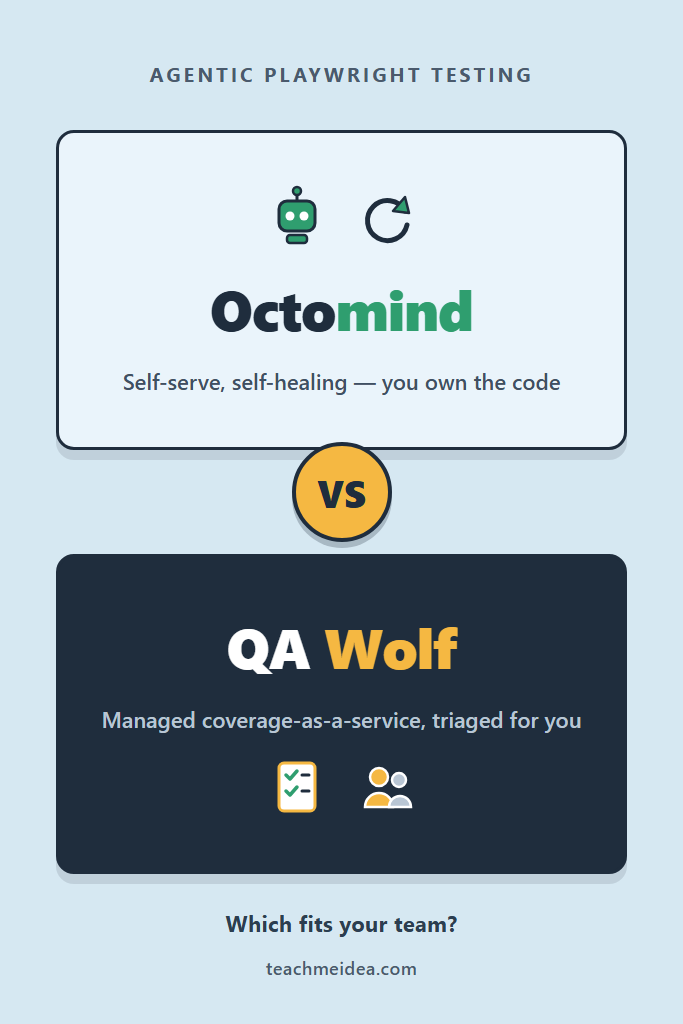
If your team writes end-to-end tests in Playwright but spends more time fixing broken selectors than shipping features, you have probably looked at agentic testing tools. Octomind vs QA Wolf is the comparison most engineering teams land on, because both promise to generate and maintain Playwright suites with AI instead of hand-written page objects. They solve the same pain, yet they sit at opposite ends of the build-versus-buy spectrum.
This guide is for engineering leads, QA engineers, and full-stack developers deciding how to cover their web app with automated tests. By the end, you will know how each tool generates tests, how they handle the flakiness problem, what you actually own afterward, and which one fits your team size, budget, and tolerance for outsourcing. We will keep the focus on practical trade-offs, not feature checklists.
What Is Octomind?
Octomind is a self-serve platform that uses AI agents to discover your app, generate Playwright tests, and keep them green as the UI changes. You point it at a URL, it crawls the application, proposes test cases, and writes them as standard Playwright code you can read, edit, and export. The locally-run components are open source, and the generated suite stays portable.
The defining idea is that you stay in control of the code. Octomind handles the boilerplate, the selector strategy, and the self-healing, while your team owns the repository. Product managers, QA, and engineers can all create cases visually, and the agent translates those into maintainable test files. Tests run locally or in Octomind’s cloud, and the platform integrates with GitHub and Azure DevOps to trigger runs on each pull request.
Because Octomind is tool-shaped rather than service-shaped, it appeals to teams that want automation without handing the work to an outside firm. It also ships an MCP server, so you can drive test generation from an AI coding agent. If you are new to that protocol, our guide to the Model Context Protocol explains how MCP lets agents call external tools.
What Is QA Wolf?
QA Wolf is a managed testing service built on top of Playwright and Appium. Rather than selling you a tool, it sells outcomes: dedicated QA engineers, backed by AI, build and maintain your test suite and guarantee a target level of coverage. The pitch is “coverage as a service,” and the headline promise is comprehensive end-to-end coverage with the flaky tests filtered out before they reach your team.
Under the hood, QA Wolf uses what it calls Automation AI to turn natural-language descriptions of workflows into deterministic Playwright or Appium code. A separate Mapping AI explores your app and documents flows, pulling in domain knowledge from your team to fill gaps. Humans review and finalize the generated tests, which is the key difference from a pure self-serve tool. The result is a hybrid: AI does the heavy lifting, people guarantee the quality.
QA Wolf also runs your suite in parallel on its own infrastructure, triages failures, and only surfaces genuine bugs. That triage layer is what teams are really paying for, because it removes the maintenance burden entirely. Tests remain exportable, so you are not permanently locked in.
Octomind vs QA Wolf: Key Differences
The clearest way to frame Octomind vs QA Wolf is build-assist versus done-for-you. Octomind gives your team a faster way to build and maintain tests. QA Wolf removes the team from the loop and delivers a maintained suite as a service. That single distinction drives most of the table below.
| Dimension | Octomind | QA Wolf |
|---|---|---|
| Model | Self-serve platform | Managed service plus self-serve tier |
| Who writes tests | Your team, AI-assisted | QA Wolf engineers, AI-assisted |
| Underlying framework | Playwright | Playwright and Appium |
| Mobile/native support | Web-focused | Web and native mobile |
| Maintenance | Self-healing agent | Fully outsourced |
| Failure triage | You review failures | They triage, surface real bugs |
| Pricing shape | Usage/seat-based, lower entry | Annual contract, higher floor |
| Open source | Locally-run parts open source | Proprietary service |
| Best for | Teams that want to own tests | Teams that want to offload QA |
Both export real Playwright code, so neither traps your tests in a closed format. Both also hook into CI to run on pull requests. The divergence is in ownership and ongoing effort, not in the test format itself.
How Each Tool Generates Tests
Octomind’s discovery agent crawls your app and proposes test cases, which you accept or refine. Generation is interactive and fast, and the output is committed code you can diff in a normal review. Because you see every test, the learning curve is real but the transparency is high.
QA Wolf starts with Mapping AI building a model of your app, then Automation AI converts agreed workflows into code. A human QA engineer reviews each test before it lands. You describe what matters in plain language; they return finished, vetted tests. The trade-off is less day-to-day visibility in exchange for far less work.
How Each Tool Handles Flaky Tests
Flakiness is the reason most E2E suites get abandoned, so this is where the comparison matters most. Octomind attacks flakiness with self-healing selectors: when the DOM shifts, the agent updates locators automatically and reports the change, which keeps the suite stable without manual edits. You still own the triage decision when a test legitimately fails.
QA Wolf attacks the same problem with a triage team. Its infrastructure runs tests in parallel, re-runs suspected flakes, and a human confirms whether a failure is a real bug before it reaches you. As a result, the signal your developers see is cleaner, but you depend on an external SLA rather than your own process. For background on why flaky suites erode trust, see our breakdown of what code coverage metrics actually mean.
A Realistic Adoption Scenario
Consider a mid-sized SaaS team of roughly 15 engineers with no dedicated QA hire. Their Playwright suite started strong but, over several months, drifted into a state where a third of runs fail for reasons nobody trusts. They have two realistic paths.
With Octomind, an engineer connects the app, lets the discovery agent regenerate the core flows, and wires runs into the existing GitHub Actions pipeline. Within a sprint, the team has a stable suite they still own, and self-healing absorbs most selector churn. The cost is mostly the platform fee plus a few hours a week of engineer attention. This fits teams that want to keep testing in-house but cannot justify a full QA function.
With QA Wolf, the same team hands over their workflows and, after an onboarding period, receives a maintained suite plus triaged results. Developers stop touching tests almost entirely. The cost is a larger annual contract, and the team accepts less granular visibility into the suite. This fits teams that would rather buy coverage outright than build the muscle internally.
Notably, neither path locks the team in, because both export Playwright code. A team can start with QA Wolf for speed, then pull the suite in-house later if budgets tighten. If you are setting up Playwright from scratch either way, our Playwright setup and patterns guide covers the fundamentals these tools build on.
What the Generated Tests Look Like
Both tools emit ordinary Playwright, which means you can read and version it like any other code. A login flow either tool might generate looks roughly like this:
import { test, expect } from '@playwright/test';

test('user can log in with valid credentials', async ({ page }) => {
  await page.goto('https://app.example.com/login');

  // Stable locators reduce flakiness; both tools prefer role/test-id over CSS
  await page.getByLabel('Email').fill('qa-user@example.com');
  await page.getByLabel('Password').fill(process.env.TEST_PASSWORD!);
  await page.getByRole('button', { name: 'Sign in' }).click();

  // Assert on a post-login signal, not a fixed timeout
  await expect(page.getByRole('heading', { name: 'Dashboard' })).toBeVisible();
});
The reason this pattern matters is that role-based and label-based locators survive cosmetic UI changes far better than brittle CSS or XPath selectors. Octomind’s self-healing and QA Wolf’s triage both lean on this convention, which is why their output reads like tests a careful engineer would write by hand. You should still review generated tests for meaningful assertions, since an agent can produce a passing test that asserts almost nothing.
Wiring Either Tool Into CI
Whichever you choose, the suite ultimately runs in your pipeline or theirs on every pull request. A minimal GitHub Actions job that runs an exported Playwright suite looks like this:
name: e2e
on: [pull_request]

jobs:
  playwright:
    runs-on: ubuntu-latest
    steps:
      - uses: actions/checkout@v4
      - uses: actions/setup-node@v4
        with:
          node-version: 20
      - name: Install dependencies
        run: npm ci
      - name: Install Playwright browsers
        run: npx playwright install --with-deps
      - name: Run E2E tests
        run: npx playwright test
        env:
          TEST_PASSWORD: ${{ secrets.TEST_PASSWORD }}
Octomind typically triggers its cloud runs from this same hook or runs the exported suite directly. QA Wolf, by contrast, usually runs the suite on its own infrastructure and reports status back to the PR. For a deeper walkthrough of pipeline design, our CI/CD for Node.js with GitHub Actions guide covers caching, secrets, and matrix runs that apply here too.
When to Use Octomind vs QA Wolf
Both tools are credible, so the decision comes down to who maintains the suite and how much you want to spend. The bullets below separate the two clean fits and the mistakes teams make with each.
When to Use Octomind
- Your team wants to own the test code and review every generated case
- You have engineers willing to spend a few hours a week on test health
- You need a lower entry cost and usage-based pricing
- You want an open, MCP-ready tool you can drive from an AI coding agent
- Your app is primarily web, not native mobile
When to Use QA Wolf
- You have no dedicated QA function and do not want to build one
- You want failures triaged so developers only see real bugs
- You need native mobile coverage alongside web
- You can justify an annual contract in exchange for offloaded maintenance
- Speed to broad coverage matters more than day-to-day visibility
When NOT to Use Either
- Your app has trivial UI and unit or integration tests already cover the risk
- You need millisecond-level performance testing rather than functional E2E
- Your flows are so unstable that any suite would churn constantly; stabilize the app first
- Compliance forbids a third party touching your application or data, which rules out the managed model
Common Mistakes With Agentic Test Tools
- Treating generated tests as final and never reviewing their assertions
- Expecting self-healing or triage to fix flakiness caused by genuinely non-deterministic app behavior
- Generating hundreds of shallow tests instead of a focused suite of critical-path flows
- Ignoring the exported code until you want to leave, then discovering nobody understands it
- Skipping the human review step that both tools assume you will do
Is Octomind or QA Wolf Better for Small Teams?
For most small teams, Octomind is the better starting point because it costs less and keeps tests in-house, while QA Wolf wins once you can fund a contract and want QA fully off your plate. A solo developer or a startup pre-revenue rarely needs the managed model, whereas a Series A company scaling its release cadence often does. The honest answer is that team size and budget decide this more than features.
If you are still building your testing foundation, it helps to understand where AI fits across the stack. Our overview of generating tests with large language models covers the unit-test layer, and Playwright MCP server testing shows how agent-driven E2E generation works at the protocol level.
Conclusion
Octomind vs QA Wolf is ultimately a build-assist versus done-for-you decision, not a feature shootout. Choose Octomind when you want to own a self-healing Playwright suite at a lower cost and have engineers to steer it. Choose QA Wolf when you would rather buy comprehensive, triaged coverage and remove testing from your team’s plate entirely. Because both export real Playwright code, you can start with one and switch later without throwing away your work.
The practical next step is to run a single critical flow through whichever model fits your budget, then judge the generated tests by their assertions, not their count. From there, explore our Playwright setup and patterns guide to make sure the suite you adopt rests on solid fundamentals.