This post is for Flutter developers and tech leads deciding when to raise their environment.sdk lower bound to 3.13. The Dart 3.13 breaking changes look small on paper: final and var are no longer allowed on ordinary parameters, and one type promotion rule moved. However, nobody has counted how much real code that touches, or what the new dart migrate command does to a Flutter app. So this post runs it. It bumps 100 active open source Flutter apps to ^3.13.0 at pinned commits, analyzes each one, and then tries three ways to fix the result. As a result, you get the real breakage rate and a safe upgrade order.
The numbers in this post came from this environment:
Measured 2026-11-19
Windows 11 Pro 25H2 (build 26200), AMD Ryzen 5 8600G (6C/12T), 16 GB RAM
Flutter 3.50.0 stable (framework ab2912035e), Dart 3.14.0, DevTools 2.61.0
Git 2.48.1 (Git for Windows), GNU bash 5.2.37, GNU Awk 5.0.0
Every repo read at the default-branch HEAD SHA recorded on 2026-11-16
Fresh pub cache, shared by all 100 apps
These are analyzer error counts, not timings. Therefore the Windows machine does not change them, and there is no run-to-run spread to report. Each app was checked once, at a pinned commit, and the full per-app table is published alongside the post, so anyone can re-run a row and compare.
Dart 3.13 Breaking Changes in 100 Apps: The Short Answer
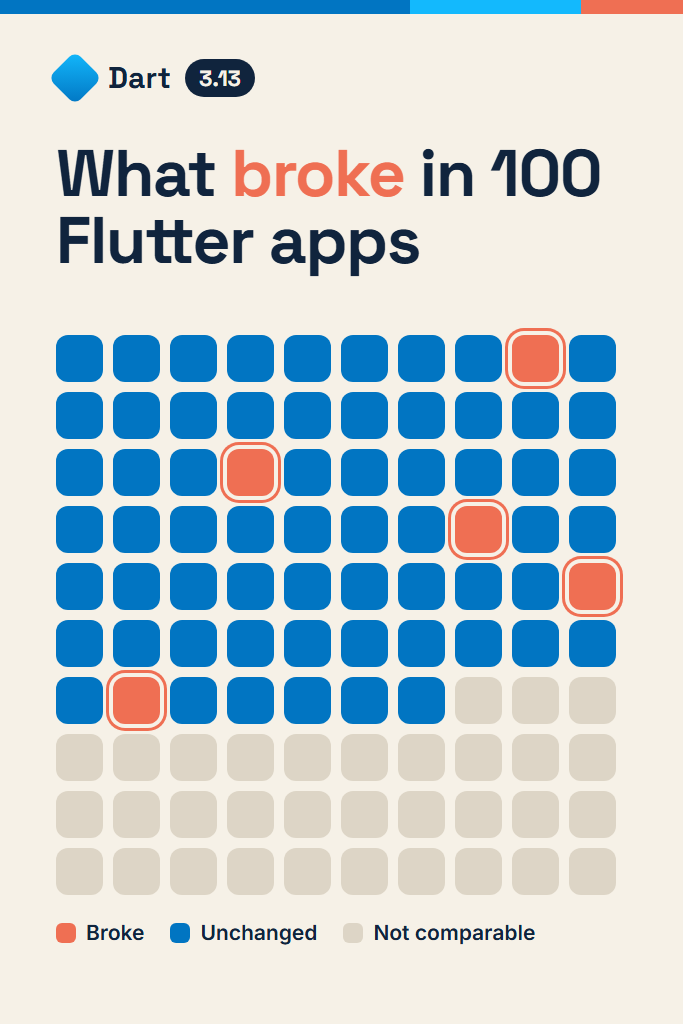
Of 67 apps that resolve their dependencies before and after the bump, 5 gained analyzer errors. Four of them hit the final parameter change, with 22 errors in 7 files, and one targeted dart fix command cleared all four. In contrast, dart migrate left 48 of the 54 apps it bumped with more errors than they started with.
| Step | Apps affected | What happened |
|---|---|---|
Bump sdk to ^3.13.0 by hand | 5 of 67 | New errors; 4 from final parameters, 1 from an older rule |
dart fix --apply --code=extraneous_modifier | 4 of 4 fixed | Back to the starting error count |
dart fix --apply, every fix | 34 of 67 worse | Material import rewrite causes new errors |
dart migrate --apply --target-sdk 3.13.0 | 48 of 54 worse | Imports rewritten, material_ui never added |
| Type promotion change | 0 of 67 | No app hit it |
In other words, the language change itself is a non-event for most apps. Instead, the risk sits in the tools you would reach for to apply it, because on Flutter 3.50 those tools also run the new Material and Cupertino migration. The rest of this post shows the commands, the raw output, and where each number comes from.
What Actually Changed in Dart 3.13
Dart 3.13 adds primary constructors, which let a class declare its fields in the constructor header. To make room for that syntax, the Dart changelog lists this under 3.13.0:
Breaking change: You can no longer use
finalorvaron non-declaring parameters. Dart now reserves both for declaring parameters in primary constructors.
The second listed break is a minor change to type promotion. Both only apply once a package opts into language version 3.13, which happens when the lower bound of environment.sdk reaches 3.13. Consequently, upgrading the SDK alone breaks nothing; bumping the pubspec is the trigger. The Dart 3.13 announcement covers the feature side, and the Dart language features overview explains how language versions gate new syntax.
Here is the pattern that breaks. Under 3.13, the analyzer reports Can't have modifier 'final' here. on the parameter:
import 'package:flutter/widgets.dart';

extension ScrollControllerPaging on ScrollController {
  // Before 3.13: legal, and some lint setups asked for it.
  // At language version 3.13: EXTRANEOUS_MODIFIER error on `final`.
  bool isNearBottom(final double thresholdPx) {
    if (!hasClients) return false;
    return position.maxScrollExtent - position.pixels <= thresholdPx;
  }
}
The fix is to delete the keyword. If the point of final was to stop reassignment inside the body, the changelog suggests the parameter_assignments lint instead, which enforces the same rule across the whole package:
import 'package:flutter/widgets.dart';

extension ScrollControllerPaging on ScrollController {
  // `parameter_assignments` in analysis_options.yaml now guards reassignment.
  bool isNearBottom(double thresholdPx) {
    if (!hasClients) return false;
    return position.maxScrollExtent - position.pixels <= thresholdPx;
  }
}
Two more changes landed around the same time and matter for this run. First, Dart 3.14 ships a new dart migrate command. According to the dart migrate docs, it runs a prepare step that “applies automated fixes for code that breaks or changes behavior in the target language version”, then bumps the constraint one minor version at a time. Second, Flutter 3.50 formally deprecates package:flutter/material.dart and package:flutter/cupertino.dart in favour of the new material_ui and cupertino_ui packages, as the Flutter migration guide describes. That deprecation is not a Dart 3.13 change. Even so, it ends up inside every automated fix below.
The 100 Apps and the Pipeline
This run reuses the corpus from the Flutter folder structure survey, which in turn comes from the Flutter state management 2026 survey. In short, it started from the 1,000 most-starred repos in GitHub’s flutter-app topic, dropped forks, archived repos and example collections, and kept the 100 most-starred apps with a commit in the 12 months before 2026-11-16. Each repo is read at the same SHA as in those posts.
Fetching Only the Files the Analyzer Needs
The analyzer needs Dart sources, YAML, ARB files and lockfiles, not images or native code. So each repo is fetched as a sparse, blobless clone at its pinned commit:
#!/usr/bin/env bash
# Fetch one repo at a pinned commit, keeping only what dart analyze reads.
# Usage: ./fetch.sh owner/repo <commit-sha> <dest-dir>
set -euo pipefail

repo="$1"; sha="$2"; dest="$3"
mkdir -p "$dest" && cd "$dest"
git init -q
git config core.longpaths true   # some Windows paths exceed 260 chars
git remote add origin "https://github.com/$repo.git"
git sparse-checkout set --no-cone '/**/*.dart' '/**/*.yaml' '/**/*.yml' \
  '/**/*.arb' '/**/pubspec.lock'
# Commits and trees first; blobs only for the sparse paths on checkout.
git fetch -q --depth 1 --filter=blob:none origin "$sha"
git checkout -q FETCH_HEAD
Five Analyses Per App
Next, one script runs the same steps against every app. It analyzes the code as committed, then after a hand bump, then after each of three fixes. Between fixes it resets the working tree, so every fix starts from the same state:
#!/usr/bin/env bash
# Usage: run-one.sh owner/repo app-dir/   (repo fetched by fetch.sh)
# Writes out/owner__repo/{a0,a1,a2,a4,a3}.txt in dart analyze machine format.
set -u
S="${SCRATCH:?}"; FL="$S/sdk/flutter/bin/flutter"; DA="$S/sdk/flutter/bin/dart"
export PUB_CACHE="$S/pub-cache" FLUTTER_SUPPRESS_ANALYTICS=true
repo="$1"; app="${2:-.}"; key="${repo//\//__}"
root="$S/repos/$key"; dir="$root/$app"; out="$S/out/$key"
rm -rf "$out"; mkdir -p "$out"

restore() { git -C "$root" checkout -q -- . ; git -C "$root" clean -fdq -e .dart_tool >/dev/null; }
pubget()  { ( cd "$dir" && timeout 600 "$FL" pub get >"$out/$1.log" 2>&1 ); echo $? > "$out/$1.rc"; }
analyze() { ( cd "$dir" && timeout 900 "$DA" analyze --format=machine . >"$out/$1.txt" 2>&1 ); }
# Raise only the sdk lower bound, keeping the file's own indentation.
bump() {
  awk '/^environment:/{e=1;print;next} e&&/^[^ #]/{e=0}
       e&&/^[ \t]+sdk:/&&!d{match($0,/^[ \t]+/);print substr($0,1,RLENGTH) "sdk: ^3.13.0";d=1;next}
       {print}' "$dir/pubspec.yaml" > "$dir/pubspec.yaml.new" && mv "$dir/pubspec.yaml.new" "$dir/pubspec.yaml"
}

restore
pubget g0; analyze a0                                      # 0: as committed
bump; pubget g1; analyze a1                                # 1: hand bump
( cd "$dir" && "$DA" fix --dry-run >"$out/fixdry.txt" 2>&1 )
( cd "$dir" && "$DA" fix --apply --code=extraneous_modifier >"$out/fixem.txt" 2>&1 )
analyze a2                                                 # 2: targeted fix only
restore; bump
( cd "$dir" && "$DA" fix --apply >"$out/fixapply.txt" 2>&1 )
pubget g2; analyze a4                                      # 4: every dart fix
restore; pubget g3
( cd "$dir" && "$DA" migrate --apply --target-sdk 3.13.0 >"$out/migapply.txt" 2>&1 )
pubget g4; analyze a3                                      # 3: dart migrate
restore
On Windows, the binaries are flutter.bat and dart.bat, which is the only change the script needs there. Every app got its own fresh analysis; nothing carries over except the shared pub cache.
Why the Count Uses 67 Apps, Not 100
An analyzer run on an app whose dependencies do not resolve reports thousands of errors that have nothing to do with Dart 3.13. For that reason, the comparison only uses apps where flutter pub get succeeded both as committed and after the bump. As committed, 30 of the 100 apps failed to resolve against Flutter 3.50. Three more resolved as committed but not after the bump. That leaves 67 apps, with 2,950,717 lines of hand-written Dart under lib/, generated files excluded. The other 33 rows are still in the published table, marked by their resolves columns.
Raw Output: The Tally
A short awk script reads the per-app table and prints every number in the short answer. Column 22 is the “resolves after the bump” flag:
#!/usr/bin/env bash
# Tally results.tsv (one row per app). Usage: ./tally.sh results.tsv
# The comparable set: apps whose dependencies resolve both as committed and after the bump.
set -euo pipefail
awk -F'\t' '
NR == 1 { next }
{ all++; if ($5 == "yes") res++ }
$5 == "yes" && $22 == "yes" {
  n++
  if ($8 > $6)  broke++
  if ($9 > 0)   { fp++; fpe += $9; fpf += $10 }
  if ($9 > 0 && $12 <= $6) restored++
  if ($7 > 0)   mat++
  if ($14 == "no") fixpub++
  if ($15 > $6) fixworse++
  if ($16 == "migrated") { mig++; if ($20 > $6) migworse++; if ($19 > 0) migdep++ }
}
END {
  printf "apps scanned                          %d\n", all
  printf "resolve as committed                  %d\n", res
  printf "resolve before and after the bump     %d\n", n
  printf "  more errors after the bump          %d\n", broke
  printf "  final/var parameter errors          %d apps, %d errors, %d files\n", fp, fpe, fpf
  printf "  restored by --code=extraneous_mod.  %d of %d\n", restored, fp
  printf "  deprecated material/cupertino use   %d\n", mat
  printf "  full dart fix: pub get fails        %d\n", fixpub
  printf "  full dart fix: more errors          %d\n", fixworse
  printf "  dart migrate bumped the SDK         %d\n", mig
  printf "    more errors after migrate         %d\n", migworse
  printf "    material_ui added to pubspec      %d\n", migdep
}' "$1"
The output, unedited:
apps scanned                          100
resolve as committed                  70
resolve before and after the bump     67
  more errors after the bump          5
  final/var parameter errors          4 apps, 22 errors, 7 files
  restored by --code=extraneous_mod.  4 of 4
  deprecated material/cupertino use   60
  full dart fix: pub get fails        2
  full dart fix: more errors          34
  dart migrate bumped the SDK         54
    more errors after migrate         48
    material_ui added to pubspec      2
The last line needs a caveat, which the dart migrate section below explains. Both of those apps already listed material_ui before the run, so the migration added it to none.
The Four Apps That Hit the final Parameter Error
Only four apps produced EXTRANEOUS_MODIFIER errors after the bump. Here is the first analyzer line from each, with the scratch path shortened to the repo:
ERROR|SYNTACTIC_ERROR|EXTRANEOUS_MODIFIER|mitesh77__Best-Flutter-UI-Templates\best_flutter_ui_templates\lib\main.dart|46|12|5|Can't have modifier 'final' here.
ERROR|SYNTACTIC_ERROR|EXTRANEOUS_MODIFIER|Sameera-Perera__Flutter-TDD-Clean-Architecture-E-Commerce-App\lib\core\extension\scroll_controller_extensions.dart|5|7|5|Can't have modifier 'final' here.
ERROR|SYNTACTIC_ERROR|EXTRANEOUS_MODIFIER|Robert-Stackflow__CloudOTP\lib\TokenUtils\Otp\otp.dart|161|7|5|Can't have modifier 'final' here.
ERROR|SYNTACTIC_ERROR|EXTRANEOUS_MODIFIER|Robert-Stackflow__Loftify\lib\Widgets\PostItem\recommend_flow_item_builder.dart|14|5|5|Can't have modifier 'final' here.
Two of them, the most-starred app in the corpus and a Clean Architecture sample, have exactly one error each. Meanwhile, CloudOTP accounts for 17 of the 22, and 12 of those sit in vendored copies of third-party widgets under third-party/. In other words, the change mostly finds code written by people who put final on parameters as a style rule, and that habit clusters in a few codebases rather than spreading thinly across many.
Put differently, 22 errors across apps holding nearly three million lines under lib/ is a tiny surface. Still, one error is enough to stop a build, so the count that matters to a team is “does my app have any”, and for 63 of 67 apps the answer was no.
The Fifth App Broke on an Older Rule
The fifth app, seasonZhu/GetXStudy, declared >=2.17.6 <3.0.0, so the bump moved it across every language version since 2.17 in one step. Its two new errors are not about Dart 3.13 at all:
ERROR|COMPILE_TIME_ERROR|UNDEFINED_IDENTIFIER|seasonZhu__GetXStudy\lib\base\pure_get_cupertino_app.dart|232|22|1|Undefined name '_'.
ERROR|COMPILE_TIME_ERROR|UNDEFINED_IDENTIFIER|seasonZhu__GetXStudy\lib\base\pure_get_cupertino_app.dart|252|22|1|Undefined name '_'.
Since Dart 3.7, a parameter named _ is a wildcard and no longer binds a name, so code that reads _ inside a callback stops compiling. Therefore an app jumping from 2.x straight to 3.13 inherits every intermediate break, not just the latest. The Flutter breaking changes by release list is the place to check those in order.
Fixing Only the Break With dart fix
The analyzer error carries a fix, and dart fix can apply just that one code. Here is the raw output for CloudOTP, the app with the most errors:
dart fix --apply --code=extraneous_modifier
Computing fixes in robert-stackflow__cloudotp...
Applying fixes...

lib\TokenUtils\Otp\otp.dart
  extraneous_modifier - 3 fixes

lib\Utils\Base32\base32.dart
  extraneous_modifier - 2 fixes

third-party\widget\animated_tree_view\lib\tree_view\tree_view.dart
  extraneous_modifier - 8 fixes

third-party\widget\pinput\lib\src\widgets\widgets.dart
  extraneous_modifier - 4 fixes

17 fixes made in 4 files.
After it, all four apps returned to exactly their pre-bump error count. For example, CloudOTP went from 471 errors as committed, to 488 after the bump, and back to 471. Those 471 were there before the bump, so they are not Dart 3.13’s doing. The diff touches only the parameter lists and nothing else, which makes it easy to review.
What a Full dart fix –apply Does on Flutter 3.50
Running dart fix --apply with no --code applies every fix the analyzer and the enabled lints offer. On Flutter 3.50 that includes migrate_design_widgets, which rewrites package:flutter/material.dart imports to package:material_ui/material_ui.dart and adds the new packages to the pubspec. Sixty of the 67 apps still import the deprecated libraries, so nearly every app gets that rewrite.
As a result, 34 of 67 apps ended with more errors than they started with. The new error codes, counted across those apps, point at the rewrite rather than at Dart 3.13:
apps  errors  code
22    334     ARGUMENT_TYPE_NOT_ASSIGNABLE
20    116     AMBIGUOUS_IMPORT
17    105     NON_CONSTANT_LIST_ELEMENT
 8   4986     UNDEFINED_METHOD
 7     74     UNDEFINED_NAMED_PARAMETER
The most common cause is a type that now exists twice. For instance, GlobalMaterialLocalizations comes from both flutter_localizations and material_ui:
ERROR|COMPILE_TIME_ERROR|AMBIGUOUS_IMPORT|mateusz-bak__openreads\lib\core\helpers\locale_delegates\locale_delegate_nynorsk.dart|23|13|27|The name 'GlobalMaterialLocalizations' is defined in the libraries 'package:flutter_localizations/src/material_localizations.dart (via package:flutter_localizations/flutter_localizations.dart)' and 'package:material_ui/src/global_material_localizations.dart (via 'package:material_ui/material_ui.dart' and 'package:material_ui/material_ui.dart')'.
Similarly, a dependency that still uses the SDK’s ThemeData no longer accepts the one the app now imports, because there are two classes with the same name. Here, <pub-cache> and <flutter-sdk> replace the long local paths:
ERROR|COMPILE_TIME_ERROR|ARGUMENT_TYPE_NOT_ASSIGNABLE|darkmoonight__Zest\lib\app\controller\theme_controller.dart|18|56|5|The argument type 'ThemeData (where ThemeData is defined in <pub-cache>\hosted\pub.dev\material_ui-1.11.1\lib\src\theme_data.dart)' can't be assigned to the parameter type 'ThemeData (where ThemeData is defined in <flutter-sdk>\packages\flutter\lib\src\material\theme_data.dart)'.
Two Ways the Fix Breaks pubspec.yaml
In two of those 34 apps, flutter pub get failed outright after the fix, and both failures come from how dart fix edits the pubspec. First, it inserts new dependencies with two-space indentation, even when the file uses four. Here is the diff in Best-Flutter-UI-Templates:
 environment:
-    sdk: ^3.10.3
+    sdk: ^3.13.0

 dependencies:
@@ -34,4 +34,7 @@ dependencies:
     animations: ^2.1.1

+  material_ui: any
+  vector_math: any
+  cupertino_ui: any
 dev_dependencies:
The first line of the hunk is the hand bump; the three added lines are from dart fix. Mixed indentation inside one mapping is invalid YAML, so pub stops:
Error on line 36, column 3: Expected a key while parsing a block mapping.
Second, in Scolect-ScreenTimeApp it added flutter_localizations as a hosted package. However, that package ships inside the Flutter SDK and needs sdk: flutter, so resolution fails:
Because screentime depends on flutter_localizations any which doesn't exist (could not find package flutter_localizations at https://pub.dev), version solving failed.
Both are easy to fix by hand once you know to look. Even so, they show that a broad dart fix --apply is not a safe way to take the Dart 3.13 bump on Flutter 3.50.
What dart migrate Does to a Flutter App
dart migrate is the tool built for exactly this job, so it deserves the closest look. It bumped 54 of the 67 apps. Here is the start of its summary for Best-Flutter-UI-Templates, which declared ^3.10.3:
dart migrate --apply --target-sdk 3.13.0
best_flutter_ui_templates:
  3.10.0 -> 3.11.0:
    Preparatory changes:
      0 changes made in 0 files.

    SDK constraint:
      Bumped ^3.10.3 -> ^3.11.0

  3.11.0 -> 3.12.0:
    Preparatory changes:
      0 changes made in 0 files.

    SDK constraint:
      Bumped ^3.11.0 -> ^3.12.0

  3.12.0 -> 3.13.0:
    Preparatory changes:
      320 changes made in 47 files.

      best_flutter_ui_templates/lib/app_theme.dart
        deprecated_member_use • 1 change

      best_flutter_ui_templates/lib/custom_drawer/drawer_user_controller.dart
        avoid_single_cascade_in_expression_statements • 2 changes
        deprecated_member_use • 2 changes
        prefer_if_null_operators • 2 changes
        use_super_parameters • 1 change
The app needed one change for Dart 3.13. Instead, the 3.13 prepare step made 320 changes in 47 files. Most are deprecated_member_use import rewrites, alongside style lints such as use_super_parameters and prefer_if_null_operators. That is broader than the docs suggest, since prepare is described as fixing “code that breaks or changes behavior in the target language version”.
More importantly, the rewrite points imports at package:material_ui, but dart migrate did not add that package to any pubspec. So the next analysis fails on every rewritten file:
ERROR|COMPILE_TIME_ERROR|URI_DOES_NOT_EXIST|mitesh77__Best-Flutter-UI-Templates\best_flutter_ui_templates\lib\app_theme.dart|1|8|38|Target of URI doesn't exist: 'package:material_ui/material_ui.dart'.
That single missing dependency cascades. Every Scaffold, Text and Colors in the file becomes undefined, and the app goes from 0 errors to 4,342. Across the 54 migrated apps, 44 picked up URI_DOES_NOT_EXIST this way, and 48 ended worse overall.
The six exceptions explain the rule. freeCodeCamp/mobile had 78 rewritten imports and vbalagovic/flutter-presetup had 41, yet neither gained errors, because material_ui was already in each lockfile through another dependency. In both, the analyzer only raised depend_on_referenced_packages, which is a lint. Likewise, QuantumPhysique/trale and lyskouski/app-finance already listed material_ui in their pubspecs. The remaining two had no deprecated imports to rewrite.
When dart migrate Refuses to Run
Of the 67 comparable apps, 13 were not bumped. Nine already declared 3.13 or later. Three were still on Dart 2.x, which the tool does not support, so it printed messages like The package SDK version "2.17.6" is not supported for migration. and stopped. The last one is a pub workspace member, which it rejects with “is part of a workspace and can’t be migrated independently”.
Outside the comparable set, 16 apps failed on their first step with the same message:
Failed to update .dart_tool/package_config.json for "shonenx". Try running "dart pub get" to update the package configuration, then re-run the migration.
All 16 had failed flutter pub get as committed, so the message is accurate: dart migrate needs a resolving project. One more was a second workspace member.
One result contradicts the docs, which say a failed step leaves the source files unchanged. In 2 of those 16 failed runs, Dart files were still modified. In Kyosee/VeneraX, for example, the diff deletes an if (list == null) block and adds a return null;. So check git status after any failed migration rather than trusting the summary.
How to Upgrade to Dart 3.13 Without Breaking the Build
Based on these results, this order keeps the change small and reviewable:
- Commit or stash everything, so
git diffshows only the upgrade. - Run
flutter pub geton the current constraint and confirm a cleandart analyze. - Raise only the
sdklower bound inpubspec.yamlto^3.13.0, then runflutter pub getagain. - Run
dart analyzeand look forEXTRANEOUS_MODIFIER. - Apply only that fix with
dart fix --apply --code=extraneous_modifier. - Re-run
dart analyzeand compare the error count with step 2. - Handle the Material and Cupertino migration as a separate commit, following the material_ui migration guide.
The key idea is to separate the language bump from the design library migration. Together, they produce one diff touching most files; apart, the language bump is usually a one-line pubspec change.
A Real Scenario: The Upgrade PR That Touched 47 Files
Consider a small team maintaining a mid-sized Flutter app on ^3.10.x. Someone reads that Dart 3.14 ships dart migrate, runs it on a Friday afternoon, and opens a pull request. The diff touches most of lib/: every Material import changed, constructors converted to super parameters, null checks rewritten. CI then fails with thousands of errors, because material_ui is missing from the pubspec.
At that point the team has two bad options. Reverting loses the upgrade, while fixing forward means reviewing hundreds of mechanical changes mixed with the one or two that matter. In this run, Best-Flutter-UI-Templates is exactly that case: one real 3.13 error, 320 migrate changes, and 4,342 errors afterwards.
The better path costs a few minutes. Bump the constraint by hand, apply the one targeted fix, and merge a pull request with a handful of changed lines. Then schedule the Material migration as its own task, with material_ui added first, so the import rewrite resolves on the first try.
When to Use Each Upgrade Tool
Apply the Targeted Fix When
- Your app imports
package:flutter/material.dartorcupertino.dart, as 60 of 67 tested apps do - You want a pull request a reviewer can read in a few minutes
- The analyzer shows only
EXTRANEOUS_MODIFIERafter the bump, which was the case in 4 of 5 broken apps
Reach for dart migrate When
- The package is pure Dart, with no Flutter design library imports for it to rewrite
material_uiandcupertino_uiare already in your pubspec, so rewritten imports resolve- You are several minor versions behind and want the bump done one language version at a time
Run a Full dart fix When
- The design library migration is the goal, not a side effect of a language bump
- You can review a large diff and fix the pubspec indentation by hand afterwards
- Your lint set is one you actually want applied across the whole codebase
When NOT to Use dart migrate
- Your dependencies do not resolve yet; it fails with a
package_config.jsonmessage untilflutter pub getsucceeds - The app is still on Dart 2.x, which the tool rejects outright
- The project is a pub workspace member, which it refuses to migrate on its own
- You need a minimal diff for a release branch, since
preparealso applies style lints
Common Mistakes with the Dart 3.13 Upgrade
- Assuming the SDK upgrade itself breaks code; only the pubspec bump changes the language version
- Running every available fix and mixing the language bump with the Material migration in one commit
- Trusting a “Failed” migrate summary to mean nothing changed, when 2 of 16 failed runs still edited files
- Accepting
dart fixpubspec edits without checking indentation, which brokepub getin one app - Jumping from Dart 2.x to 3.13 and blaming 3.13 for older breaks such as wildcard
_parameters - Deleting
finalon parameters without addingparameter_assignments, if reassignment protection was the reason it was there
What This Run Does Not Cover
First, this measures analyzer errors only. No app was built, run or tested, so behavior changes that compile cleanly, including anything the type promotion change could alter at runtime, are out of scope. Warnings and infos are not counted, only ERROR severity.
Second, 33 of the 100 apps could not be compared, because their dependencies did not resolve on Flutter 3.50 before or after the bump. As a result, the 5-in-67 figure describes apps that build on the current SDK, not every app in the corpus. The full table includes them, with each step’s result where one exists.
Third, open source apps are a self-selected group, and the corpus comes from repos tagged flutter-app and sorted by stars. Commercial codebases with strict lint sets might use final on parameters more often. Finally, this used Flutter 3.50.0 with Dart 3.14.0. A later Dart release may change what dart migrate and dart fix do, and this post will be refreshed when it does.
Conclusion
Among the Dart 3.13 breaking changes, the final parameter rule is the one that showed up, and it showed up rarely. In 67 comparable Flutter apps, 4 hit it, with 22 errors in 7 files, and one targeted dart fix command cleared every one. Meanwhile, the type promotion change touched none. The real hazard is the tooling. On Flutter 3.50, both a full dart fix and dart migrate bundle the Material and Cupertino deprecation fixes into the upgrade, and dart migrate left 48 of 54 apps worse because it never adds material_ui.
So bump the constraint by hand, run dart fix --apply --code=extraneous_modifier, and ship that as its own small change. Next, plan the design library move separately with the material_ui and cupertino_ui migration guide, and keep an eye on other removals in the deprecated APIs list for 2026.
The Apps Behind These Numbers
The five apps that changed after the bump, each linked to the commit that was analyzed: mitesh77/Best-Flutter-UI-Templates (1 error), Sameera-Perera/Flutter-TDD-Clean-Architecture-E-Commerce-App (1 error), Robert-Stackflow/CloudOTP (17 errors), Robert-Stackflow/Loftify (3 errors), and seasonZhu/GetXStudy (2 wildcard errors).
The full list of 100 apps, with every commit, matches the Flutter folder structure survey. Each row of the published table records the original SDK constraint, the error count at every step, the dart fix proposal count, and the dart migrate outcome.