If you are building AI agents in production, you have probably hit the question of which open protocol to standardize on. Specifically, A2A protocol vs MCP is the comparison that comes up most often, because both ship from major AI labs and both claim to solve agent interoperability. However, they solve different halves of the problem, and picking the wrong one leads to either fragmented tool integrations or brittle multi-agent orchestration.
This guide is for engineers designing agent systems who need to choose a standard before locking in vendor dependencies. By the end, you will understand what each protocol actually does, where they overlap, and how teams use them together in production stacks.
What Is MCP?
The Model Context Protocol (MCP), released by Anthropic in late 2024, is an open standard that lets AI agents connect to external tools, data sources, and prompts through a uniform interface. Think of it as USB-C for LLM applications: instead of writing custom integrations for every data source, you wrap each source in an MCP server, and any MCP-compatible client (Claude Desktop, Cursor, your own agent) can use it.
MCP defines three primitives a server can expose:
- Tools: Functions the agent can call (e.g.,
query_database,send_email) - Resources: Read-only data the agent can fetch (e.g., file contents, API responses)
- Prompts: Reusable prompt templates the user can invoke
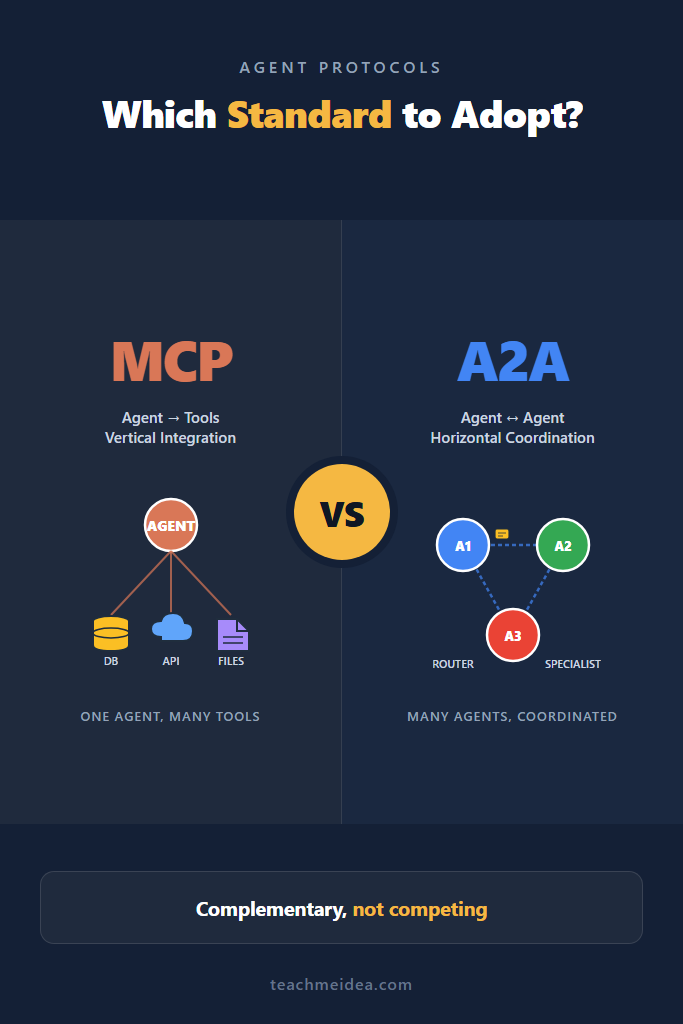
The transport is JSON-RPC 2.0, typically over stdio for local servers or HTTP with Server-Sent Events for remote ones. As a result, MCP is fundamentally vertical: it connects one agent to many tools. For a deeper foundation, see the MCP protocol explainer, which walks through the message flow in detail.
What Is the A2A Protocol?
Agent2Agent (A2A) is an open protocol introduced by Google in 2025 that standardizes how AI agents from different vendors, frameworks, or organizations communicate with each other. Where MCP connects an agent to its tools, A2A connects an agent to another agent. Specifically, it lets a customer-service agent built on LangGraph hand off a task to a billing agent built on CrewAI without either side knowing the other’s internals.
The protocol is built on HTTP, JSON-RPC, and Server-Sent Events for streaming. Each agent publishes an Agent Card, a JSON document at a well-known URL (/.well-known/agent.json) that describes the agent’s capabilities, authentication requirements, and supported input modalities. Other agents discover and call it through that card.
Core A2A concepts include:
- Agent Card: Public capability descriptor for discovery
- Task: A unit of work with a lifecycle (submitted, working, input-required, completed, failed)
- Message: A single turn within a task, containing text or structured parts
- Artifact: Generated output (files, structured data) attached to a task
Notably, A2A is horizontal: it connects many agents to many agents.
A2A vs MCP: Key Differences
The fastest way to internalize the split is to compare them side by side. The table below covers the dimensions that matter when picking a protocol.
| Dimension | MCP | A2A |
|---|---|---|
| Primary purpose | Agent-to-tool integration | Agent-to-agent communication |
| Backed by | Anthropic | Google (with 50+ partners) |
| Released | November 2024 | April 2025 |
| Direction | Vertical (one agent, many tools) | Horizontal (many agents, many agents) |
| Transport | JSON-RPC over stdio or HTTP+SSE | HTTP + JSON-RPC + SSE |
| Discovery | Static config or registry | Agent Card at well-known URL |
| State model | Stateless tool calls | Stateful task lifecycle |
| Streaming | Yes (via SSE) | Yes (via SSE) |
| Authentication | Server-defined | OpenAPI-style schemes in Agent Card |
| Native primitives | Tools, Resources, Prompts | Tasks, Messages, Artifacts |
| Best fit | Connecting an agent to APIs, DBs, files | Orchestrating specialized agents across teams |
A common misreading is that A2A replaces MCP. In practice, they target different layers of the stack. MCP standardizes what an agent can do; A2A standardizes how agents talk to each other. Google’s own A2A documentation explicitly positions it as complementary to MCP, not a substitute.
For instance, consider a research agent that needs to query a Postgres database and then delegate report formatting to a writing agent. The database connection belongs in an MCP server. The handoff to the writing agent belongs in an A2A call. Building either side with the wrong protocol creates friction that compounds as the system grows.
When to Use MCP (and When Not To)
MCP shines when the problem is connecting an LLM-driven application to the outside world. However, it is the wrong tool for orchestrating workflows across independent agents.
When to Use MCP
- You are exposing internal tools (databases, APIs, file systems) to an agent
- You want one tool implementation that works across multiple agent frameworks
- Your agent runs on Claude Desktop, Cursor, or any MCP-compatible host
- You need to share read-only context (logs, docs, configs) with an agent
- You are building developer tooling that benefits from a shared tool ecosystem (see Claude Code MCP servers)
When NOT to Use MCP
- You need agents to delegate full tasks to other agents
- The work involves long-running, stateful conversations between agents
- You want autonomous agents to discover each other dynamically at runtime
- The receiving agent needs to negotiate (ask clarifying questions, return partial results)
Common Mistakes with MCP
- Treating MCP servers as microservices and over-engineering them with complex business logic; keep them thin
- Exposing dangerous tools (shell access, write APIs) without per-tool permission scoping
- Forgetting that tools defined in MCP still need the agent’s LLM to choose them correctly; a well-defined schema matters more than clever code
- Building one giant MCP server instead of multiple focused ones, which makes capability discovery harder for the agent
When to Use A2A (and When Not To)
A2A is purpose-built for the multi-agent case, where two or more agents need to collaborate but were built independently. On the other hand, it adds operational overhead that simple single-agent systems do not need.
When to Use A2A
- You have multiple specialized agents (research, coding, summarizing) that need to coordinate
- The agents are built by different teams, vendors, or frameworks
- You want vendor-neutral orchestration that does not lock you into one framework’s runtime
- The system spans organizational boundaries (your agent calling a partner’s agent)
- You need a long-running task lifecycle with status updates and intermediate artifacts
When NOT to Use A2A
- A single agent with tool calls would solve the problem
- All your agents live inside one framework (use that framework’s native orchestration first)
- You need synchronous, low-latency RPC; A2A’s task model adds async overhead
- The work is a simple pipeline with no negotiation between stages
Common Mistakes with A2A
- Wrapping every internal function as an A2A agent; the protocol is for autonomous agents, not arbitrary services
- Skipping the Agent Card’s capability descriptions, which breaks discoverability
- Ignoring the task lifecycle and treating A2A like a one-shot RPC; the value is in handling
input-requiredand streaming states - Mixing A2A with custom protocols inside the same system, which defeats the interoperability goal
Can You Use A2A and MCP Together?
Yes, and most production agent stacks built in 2026 will. The two protocols compose cleanly because they operate at different layers.
A realistic composition looks like this. An orchestrator agent receives a user request. Internally, it uses MCP servers to query databases, read files, and call internal APIs. When part of the request needs specialized expertise (such as legal review or code generation), the orchestrator uses A2A to delegate to a specialist agent. That specialist agent, in turn, has its own MCP servers for the tools it needs.
In code terms, MCP is the SDK between an agent and its tools, while A2A is the network protocol between agents. Frameworks like LangGraph for stateful agents and CrewAI multi-agent teams are increasingly adding native support for both, so you do not have to wire the plumbing yourself.
A working pattern from production teams: build all internal tools as MCP servers from day one, even if you do not yet need multi-agent coordination. When the system grows complex enough to warrant splitting into specialized agents, wrap each agent with an A2A endpoint. The MCP investment carries forward unchanged because tools are still tools, regardless of which agent calls them.
Production Scenario: A Customer Operations Stack
Consider a mid-sized SaaS company building an AI-powered customer operations system. The work splits naturally across domains: triage (classifying tickets), billing (refunds, plan changes), and engineering escalation (querying logs and creating Jira tickets). A monolithic single-agent design tends to struggle here because the prompts, tool sets, and guardrails differ sharply between domains.
Using both protocols, the architecture looks like this:
- A router agent receives the inbound ticket and decides which specialist handles it
- A billing agent has MCP servers for Stripe, the internal subscription database, and refund policy docs
- An engineering agent has MCP servers for log search, error tracking, and Jira
- All three specialist agents expose A2A endpoints with Agent Cards describing their capabilities
When a customer asks “why was I charged twice and when will the bug be fixed,” the router invokes the billing agent via A2A to investigate the duplicate charge, then invokes the engineering agent via A2A to find the related bug ticket. Each specialist uses its own MCP tools internally without the router knowing or caring.
Critically, the engineering team can ship a new version of the billing agent (different model, different prompts, different framework) without the router changing at all, as long as the Agent Card stays compatible. That decoupling is the operational payoff for adding A2A to the stack. The foundational patterns here are covered in building AI agents with tools, planning, and execution, which lays out the single-agent design that A2A then composes.
Common Mistakes Combining A2A and MCP
Even teams that understand both protocols individually trip over a few integration gotchas:
- Duplicating capability descriptions: Listing the same tool both as an A2A capability and an MCP tool, which confuses both clients and humans reading the configuration
- Skipping authentication on A2A endpoints: Internal A2A traffic still needs auth; an Agent Card without auth schemes is an open RPC endpoint
- Putting business logic in MCP servers that should live in the agent: MCP servers should be thin wrappers around capabilities, not decision-makers
- Using A2A for sub-100ms requests: The task lifecycle is overhead you do not need for synchronous lookups; just use HTTP or gRPC
- Forgetting versioning: Both Agent Cards and MCP tool schemas evolve; consumers need to handle missing or added fields gracefully
Which Should You Adopt First?
The honest answer depends on your current architecture. In practice, most teams should start with MCP. Even if you never end up running multiple agents, the standardized tool layer pays for itself by letting you swap clients (Claude Desktop, Cursor, custom apps) without rewriting integrations. Furthermore, MCP has the larger ecosystem today, with hundreds of community servers already published.
Adopt A2A when you have a concrete second agent in the picture, either inside your organization or across a partner boundary. Adding it earlier than that is premature abstraction; the Agent Card and task lifecycle pay off only when there is real heterogeneity to manage.
The teams that get the most value from A2A protocol vs MCP planning treat them as layers, not alternatives. MCP becomes the universal tool fabric; A2A becomes the universal coordination fabric. Together, they let you build agent systems where individual pieces can be swapped, scaled, or replaced without the whole stack changing.
Conclusion
A2A protocol vs MCP is not a choice between competitors; it is a choice about which layer of agent infrastructure to standardize first. MCP solves agent-to-tool integration and should be your default for any agent that touches external systems. A2A solves agent-to-agent coordination and earns its place once you have at least two autonomous agents that need to collaborate across team or framework boundaries.
Start by wrapping your existing internal APIs as MCP servers, even for a single-agent system. Then evaluate A2A when you are ready to split your monolithic agent into specialists. For the next step, dig into Microsoft AutoGen for multi-agent frameworks or the Google ADK for production agent pipelines, both of which are adding first-class A2A support throughout 2026.